Archive | International Railway Traveler RSS feed for this section

Thailand’s “Death Railway”: Adventures on the Eastern & Oriental Express, Part I

4 Jun

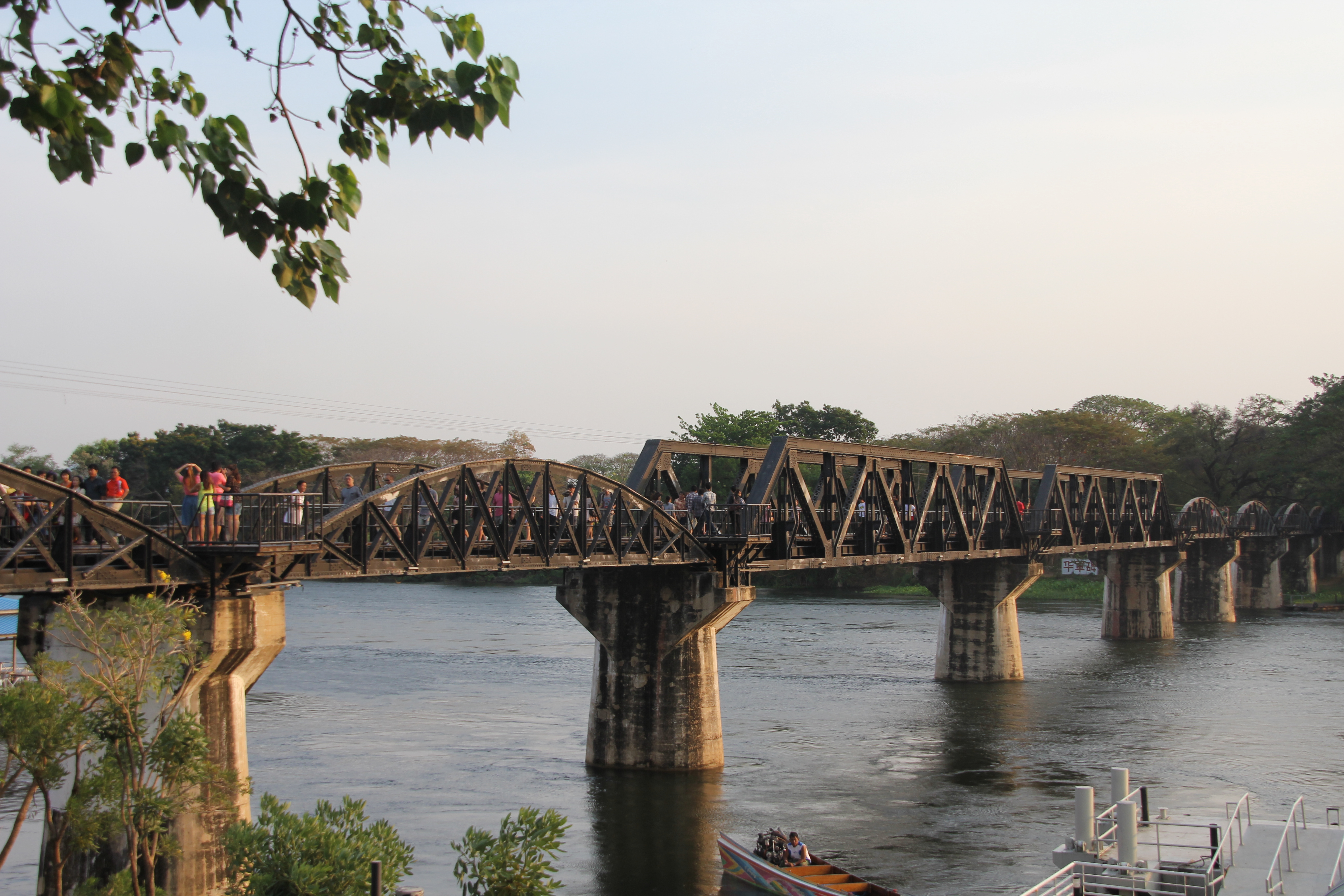
The Kwai River Bridge. IRT photo by Bruce Anderson.

Since its inception, The Eastern & Oriental Express has been on my bucket list of trains to ride. But it was IRT President Eleanor Hardy’s Track 25 blog that finally made me book the trip. And as long as I was going halfway around the world, I decided to add the standard E&O four-day Singapore-Bangkok route to the beginning of my trip.

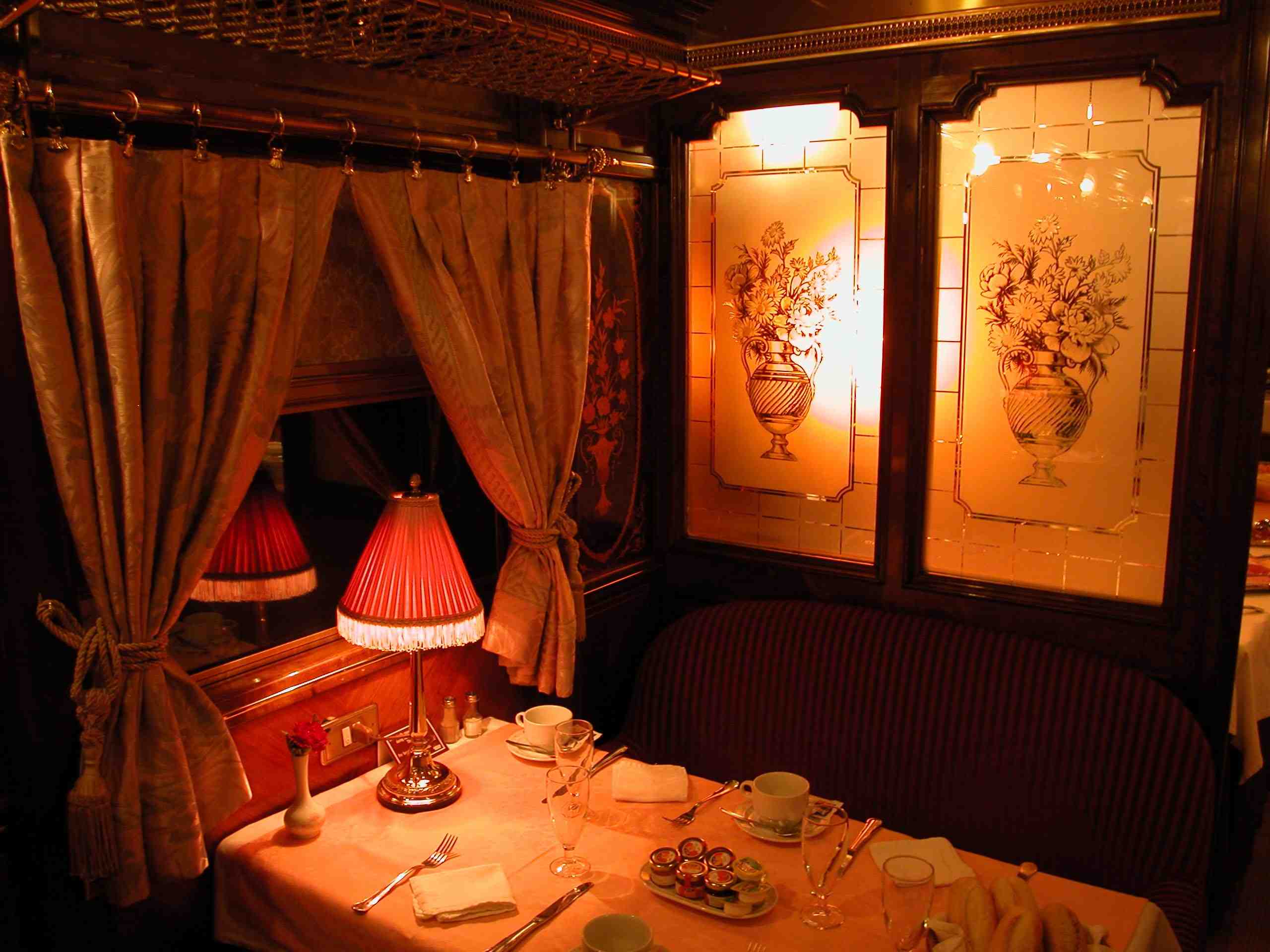
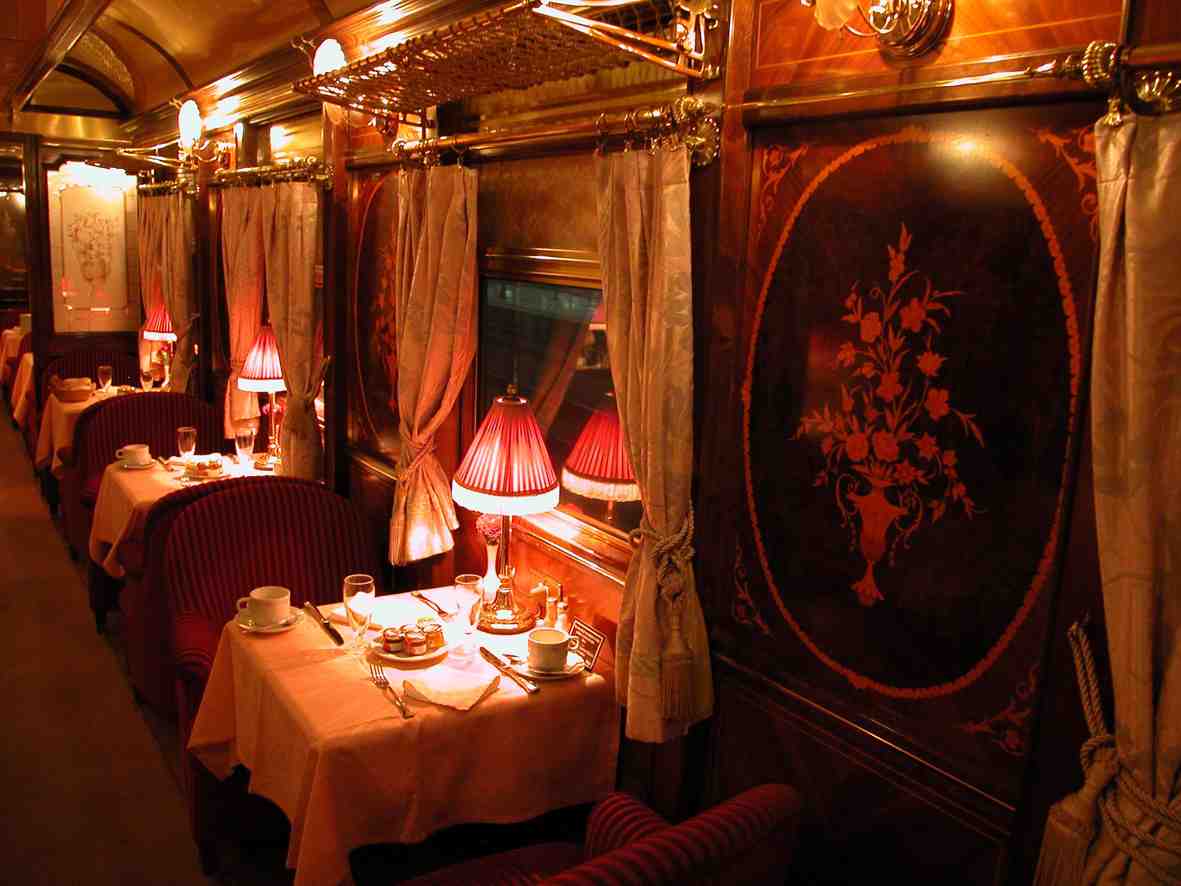
Unlike their semi-annual one-week tours (ours was Epic Thailand), this route runs regularly during high season and continues on a less frequent schedule throughout the year. In fact, the journey is more like a scheduled train than a tour, as stops are made to entrain passengers at the Malaysian cities of Kuala Lampur and Butterworth.

The train is much more than “general transportation,” however, and is every bit as impressive as outlined in Ms. Hardy’s blog. The staff is top-notch – attentive but not overbearing. What I didn’t expect was to be greeted by name by bartender Andrek asking if I was ready for my iced tea! How did he know? Of course, preferences were indicated on the booking form, but those are often a formality soon forgotten.

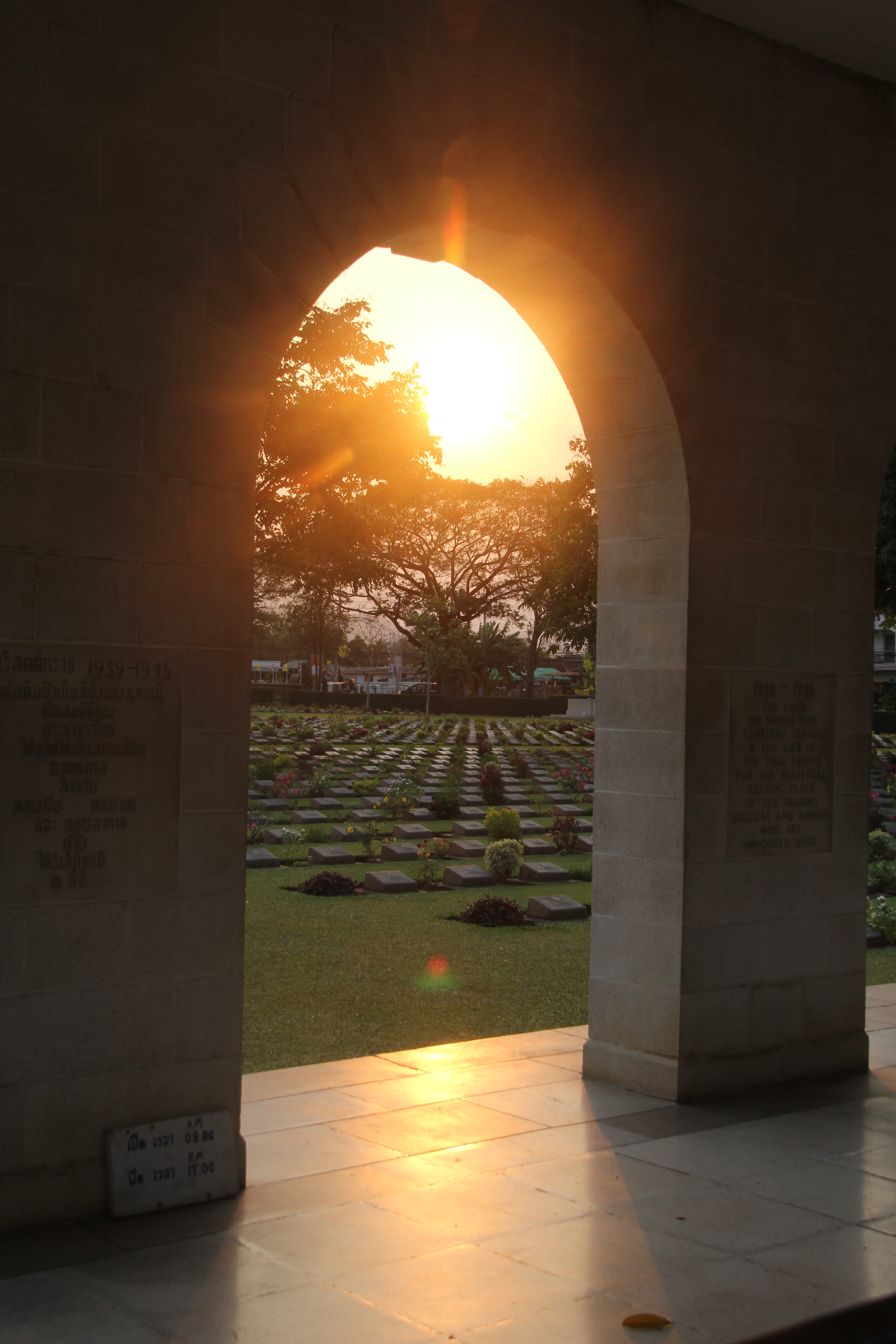
The War Cemetary at Kanachanaburi. IRT photo by Bruce Anderson.

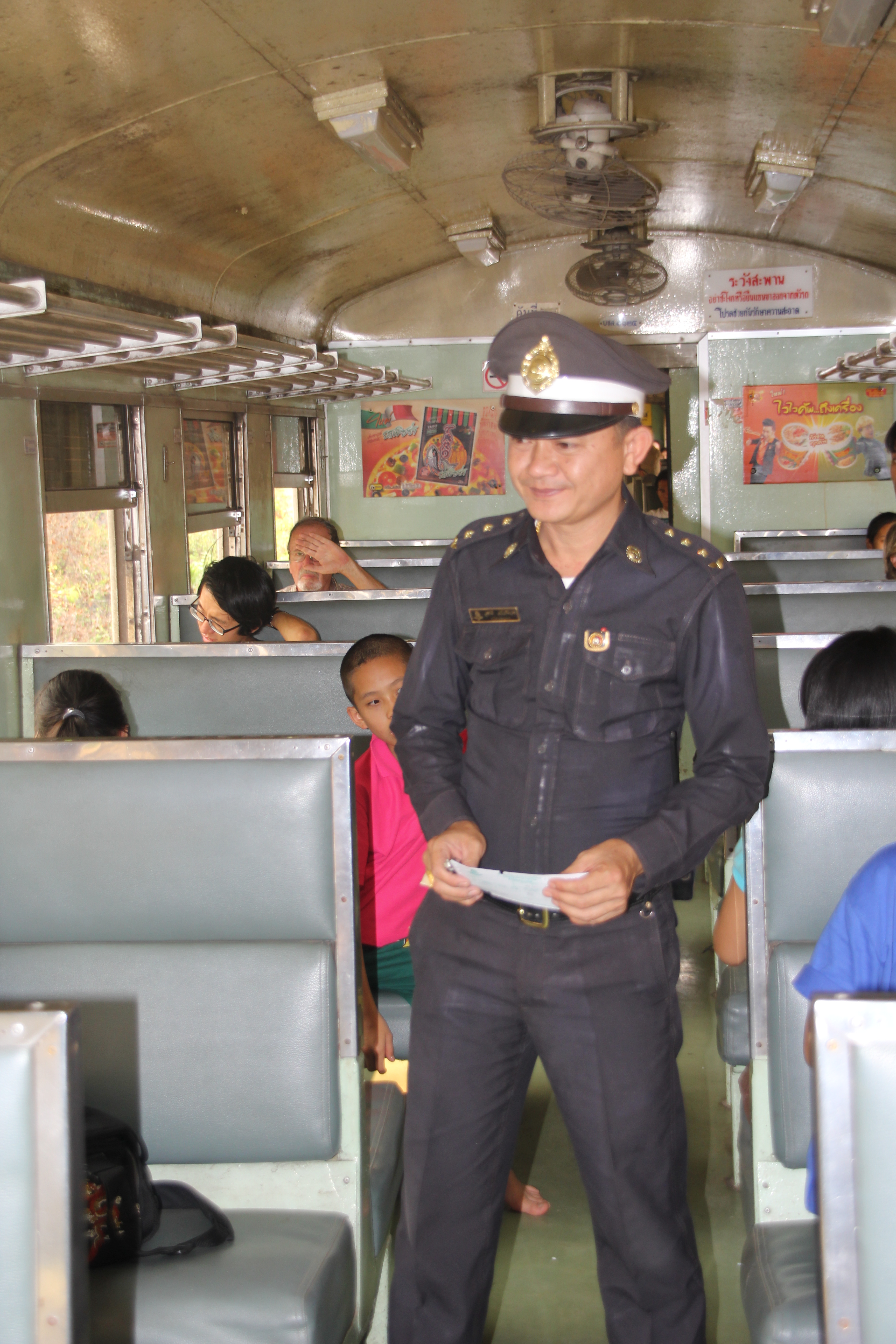
Conductor on local train. IRT photo by Bruce Anderson.

Off-train tours are offered in the colonial Malaysian city of Georgetown and to Kanchanaburi, site of the Kwai River bridge. I, however, had planned to venture out on my own, leaving the E&O at the Kwai River Station and continuing by local train to the end of the line, 45 miles north at Nam Tok.

This track is what’s left of the Thai-Burma “Death Railway,” constructed by allied prisoners of World War II and made famous by the movie “Bridge Over the River Kwai.” The Allied War Cemetery at Kanchanaburi, with over 6,000 graves, lies in silent testament to the horror of what transpired there.

But all was not going according to plan. Would I make it to Bangkok in time, I wondered, to join the 19 other IRT travelers leaving on the Epic Thailand tour?

For part II of Bruce Anderson’s adventures in Thailand, please click here.

VIA Canadian Winter Journey Unveils Top Train’s New Décor

11 Jan
The Canadian

VIA Rail's Toronto-Vancouver Canadian. Photo by Bruce Anderson

Vacations during the holiday season often conjure up images of someplace warm, perhaps celebrating some foreign country’s unique New Year’s traditions. My traditional New Year’s trip is on VIA Rail’s Canadian across Canada, often paired with my other passion: NHL Hockey.  I collect hockey arenas the same as I do rail mileage and train journeys. This time, my trip took me to Winnipeg to see a New Year’s Eve game.

It was also my 50th trip on the Canadian since 1977.
What I rode is not the much ballyhooed — and delayed — luxury service which will include completely revamped cars with dedicated attendants, larger accommodations with showers and flat screen TV’s. While waiting for that to materialize, now tentatively scheduled for 2013, the existing train has received a complete makeover. Although rooms remain the traditional Pullman size, where else except in a private railroad car can one ride a train straight out of the 1950’s?

It has been argued that today’s train isn’t the “real” Canadian, since it now mostly follows the more northerly Canadian National routing. But my consist, with the exception of one ex-Amtrak re-built coach (Amtrak, are you listening?), was made up entirely of original Canadian Pacific equipment.  All interiors have been updated with new carpeting, wall coverings, seat fabrics and lighting.

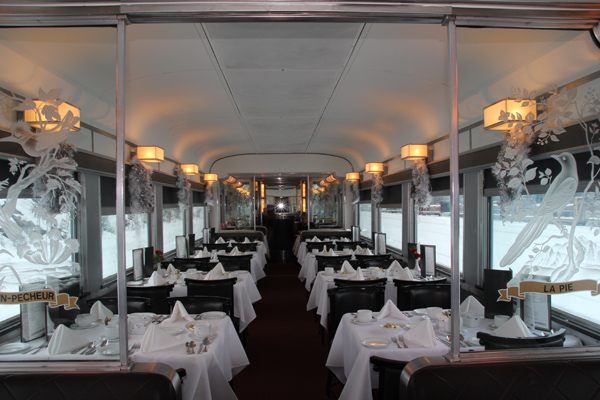
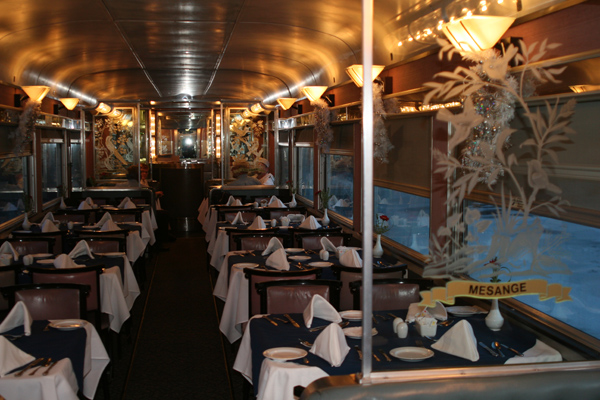
Before and after: Above, the refurbished and redecorated diner on the Canadian. Walls and ceiling are white, making the car much brighter than before. Chairs have gone from pink to dark gray. Square plastic lights have replaced the art deco ones. The dark blue seat covers for dinner also are gone. Below, the Canadian's diner before the refurbishment. Photos by Bruce Anderson

The diner, previously pretty in pink, is now brightened with white walls and ceiling with dark grey seats. The famous original etched-glass partitions have been retained. Food is of the expected high standard and service is provided in a professional manner.

Dining car on the Canadian before the recent refurbishment.

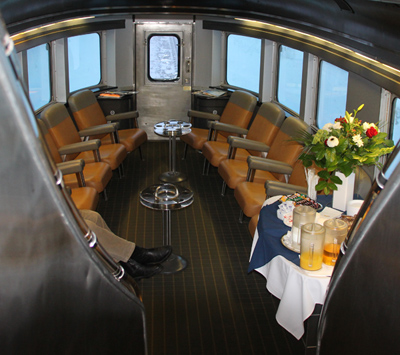
The Park Car has been darkened with dark grey ceiling and frames around the dome windows, giving a warm appearance, which draws more attention to the view outside rather than in. And if you get tired of the northern Ontario scenery, movies can be screened on a new flat screen TV in the lounge beneath the dome.

The rear Park Car on VIA's Canadian

The Canadian's Park Car, looking down from the dome stairway to the lounge area. Photo by Bruce Anderson

While accommodations are the traditional Pullman size, the Cabin for One (ex-Roomette) and Cabin for Two (ex-Bedroom) provide a cozy atmosphere in which to sleep. Unlike Amtrak, all rooms have en-suite toilet and sink; however, the shower is down the hall. Sections or “berths” also are available, the only train left in North American where they can be found. (Sections were made famous in the “naughty” sleeper scene by Marilyn Monroe, Tony Curtis and Jack Lemmon in “Some Like It Hot.”) While sleeping accommodations on the Canadian are generally priced higher than Amtrak, fares in winter are about half those in effect during peak summer season.

Some may question traveling in winter through the “Great White North.” But I enjoy the lower passenger counts, and there’s plenty of heat. Besides, what could be better than sitting in a front dome seat at night, watching the signals change from green to red as the train passes by, the moon illuminating the snow-covered ground?

The schedule is heavily padded, so arrival is likely to be on time, as it was for me in both directions. But I wouldn’t advise booking a same-day flight at trip’s end, at least not in winter.

While not the Orient Express, the Canadian is in my opinion the best we have going in North America.

Editor’s Note:  When the new luxury service debuts, the equipment and service as described above will still be available on each departure at traditional pricing, according to VIA.  The Canadian runs three times weekly in each direction between Toronto and Vancouver. The Canadian is one of The Society of International Railway Traveler’s World’s Top 25 Trains for 2012; The IRT Society’s 13-day “Trans-Canada Rail Adventure” includes three overnights on the Canadian.

Author’s Note: (I traveled to Winnipeg to see its new MTS Centre and team host the Toronto Maple Leafs. Sadly, the mighty Detroit Red Wings don’t play in Winnipeg this year).

Vic Falls’ Steam Dinner Train Delights Cape-Dar Traveler

2 Dec
Victoria Falls Dinner Train

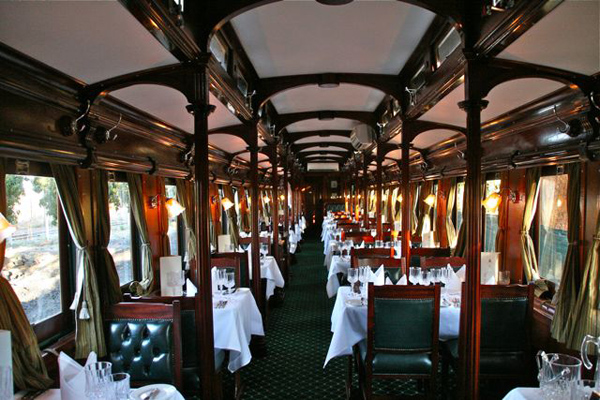
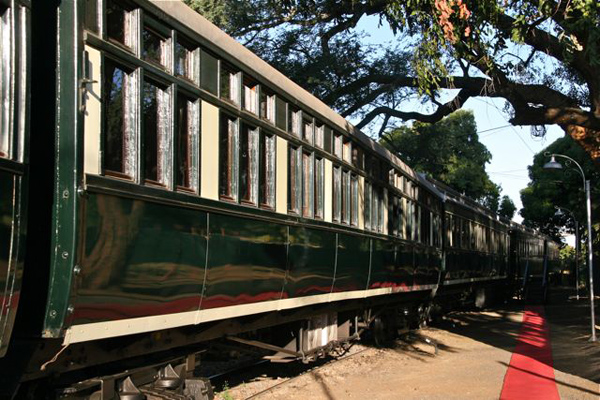
Dining Car Wembley, built in 1926. IRT Photo by Bruce Anderson

Victoria Falls is one of the great natural wonders of the world. I’ve seen it four times and never tire of the magnificent views.

But while the Falls has been called “the smoke that thunders,” few are aware that smoke of another kind can be found just across the bridge from the Victoria Falls Hotel in Zambia.

Steam Engine Class 12 of the Royal Livingstone Dinner Train

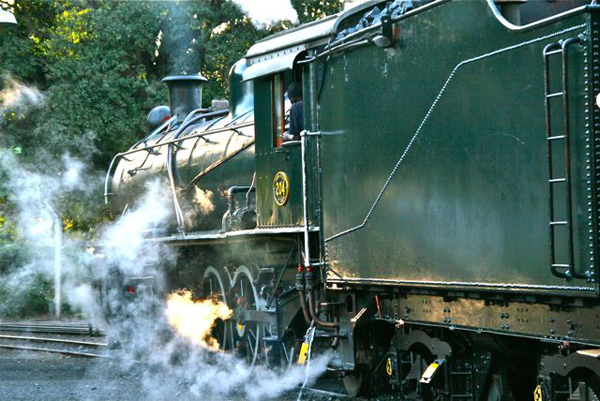
Steam engine 12th class 204, built by Northern British Locomotive works in the 1930. IRT Photo by Bruce Anderson

Nestled in a remote corner of town next to the Livingstone Railway Museum is the Royal Livingstone Express, a true throwback to the days of Rhodesian Railways’ passenger services. I had a chance to sample this vision of the past during my recent Rovos Rail trip to Dar Es Salaam with the Society of International Railway Travelers®. The Cape Town – Dar itinerary includes a overnight stop at the Falls.

Rovos groups stay at the Victoria Falls Hotel, on the Zimbabwe side. The hotel is beautiful, but it makes the trek to the dinner train a bit problematic. Getting there — one-way— included two van rides, the purchase of a double-entry visa at the Zimbabwe-Zambia border and a six-mile bus ride. But the trouble and expense are well worth it.

It is indeed quite a train.

Its five cars all have been either restored by or purchased from Rovos Rail. They include a kitchen car and two dining saloons, one of which was the unique, pillared diner “Wembly,” built in 1926. Rounding out the consist are a lounge and, bringing up the rear, an open-platform observation car.

The Royal Livingstone Express Dinner Train

The Royal Livingstone Express Dinner Train. IRT Photo by Bruce Anderson

The train’s route first took us through Livingstone, where the entire township seemed on hand to wave, with the younger set chasing after us as well. We spent the rest of our time spotting elephants as we chugged through Mosi-oa-Tunya National Park. True, most of our journey was in winter darkness. But the real attraction was what was happening inside the train.

The train’s two chefs turned out a five-course, freshly prepared meal worthy of a fine dining restaurant. It was served while the train was stopped at the far end of its five-and-a-half-mile run. Our entrée, lamb shoulder, was delicious, with the meat just about falling off the bone. A vegetarian option also was available.

After dinner, drinks were served in the two lounges during the train’s return to Livingstone. Train enthusiasts in our group were treated to the sounds and smell of a Class 12 steam locomotive. For the return trip, it ran tender first, coupled to the back of the train’s observation car. It was just about the closest one can get to a working steam locomotive without actually being on the foot plate.

Cost for the train including transfers (but excluding visas) is $160 U.S. and can be booked through The Society of IRT. Dinner runs usually are made Wednesdays and Saturdays with a minimum of 20 passengers required. Dress code is smart casual. I would highly recommend this unique experience, particularly for a second-time visitor, as I was, who has previously done some of the area’s more well-known tourist activities.

For more information on the Royal Livingstone Express, or on Rovos Rail’s Cape Town – Dar es Salaam tour, call (800) 478-4881 within the U.S. and Canada. Elsewhere, call (502) 897-1725.

2012: Lapping up Luxury as World’s Top 25 Trains Unveiled

18 Nov

When it comes to the World’s Top 25 Trains, luxury leads the way in 2012.

The Society of International Railway Travelers® is proud to announce its annual picks of the best of the best, and the trend towards true “five-star-hotel-on-wheels” status is unmistakable. Consider:

  • With its upgraded dining service and gigantic Imperial Suites, the Golden Eagle Trans-Siberian Express now is truly golden—and so we’re thrilled to award it luxury status. Congratulations to GW Travel of the UK, its operator!
  • The Canadian is adding new, luxury-level deluxe class service summer 2012;
  • Despite rumors of its being on the auction block, South Africa’s Blue Train continues its decades-old tradition of top-notch service, food  and on-board amenities, now with three luxurious Botswana safari camp add-ons;
  • Queenslander Class on Australia’s Sunlander expands to three departures in each direction weekly, even as a modernized, new Sunlander prepares to take over in 2014.
  • Spain’s luxurious Al-Andalus is scheduled to return to the broad-gauge rails next year; if the past is any indication, it’s likely to be fantastic (we won’t know for sure until we review it next spring). But if Al-Andalus joins the “Top 25,” which train gets the boot? Stay tuned!

“The trend really does seem to be headed in the direction of ever greater luxury,” said Eleanor Hardy, president of The Society of International Railway Travelers®, which compiles the annual “Top 25 List” and has been evaluating the world’s great trains since 1983. “Congratulations to all the trains and their staffs for earning this well-deserved World’s Top 25 Trains medallion.” The award is based on frank reviews of owners, staff, editors and our travelers.

Read them in our publication, available for immediate download here.

Eleanor Hardy and Blue Train chef

Eleanor Hardy, president of the Society of IRT, shares a laugh with the chef on board Africa's Blue Train. IRT photo by Owen Hardy

“My associate Angela Walker (the Society’s Vice-President, Operations) just returned from northern Spain, where she was highly impressed by the El Transcantábrico Gran Lujo, the new narrow-gauge luxury service running between Santiago and San Sebastien. Her suite occupied half a railroad car!”

These developments follow on the heels of last year’s introduction of the Maharajas’ Express in India. Its Presidential Suite, which occupies an entire train car, makes it the largest train accommodation in the world. Spend a mere $22,000 per person, and you too can enjoy two bedrooms, two bathrooms (the master includes a bathtub), and a large parlor with couch, table, chairs and desk.

India, in fact, leads the world with the greatest number of “Top 25 Trains,” totaling four. Besides the Maharajas’ Express, they include Rajasthan’s Palace on Wheels, the Delhi-Mumbai Deccan Odyssey and the tiny (and decidedly non-luxurious) Toy Train, which runs (occasionally) high into the foothills of the Himalayas to Darjeeling.

Another leader in the luxury train realm is the Orient-Express company, which is responsible for no less than six of the IRT Society’s “World’s Top 25 Trains” — five of them definitely luxurious:

  • The Venice Simplon-Orient-Express, regularly running from Paris to Venice, less often to such gems as Prague, Vienna and Budapest and — once a year, if you book far enough in advance — all the way to Istanbul;
  • The Royal Scotsman, with room for just 36 passengers, offering an intimate, panoramic taste of the best its namesake country has to offer;
  • The British Pullman,whose 1920s-vintage cars ferry passengers to the continent between London and Folkesone; it also offers day outings with historical, culinary, wine, murder mystery — even steam locomotives — as themes

    Girl in red dress on the Eastern & Oriental Express rear open-air car

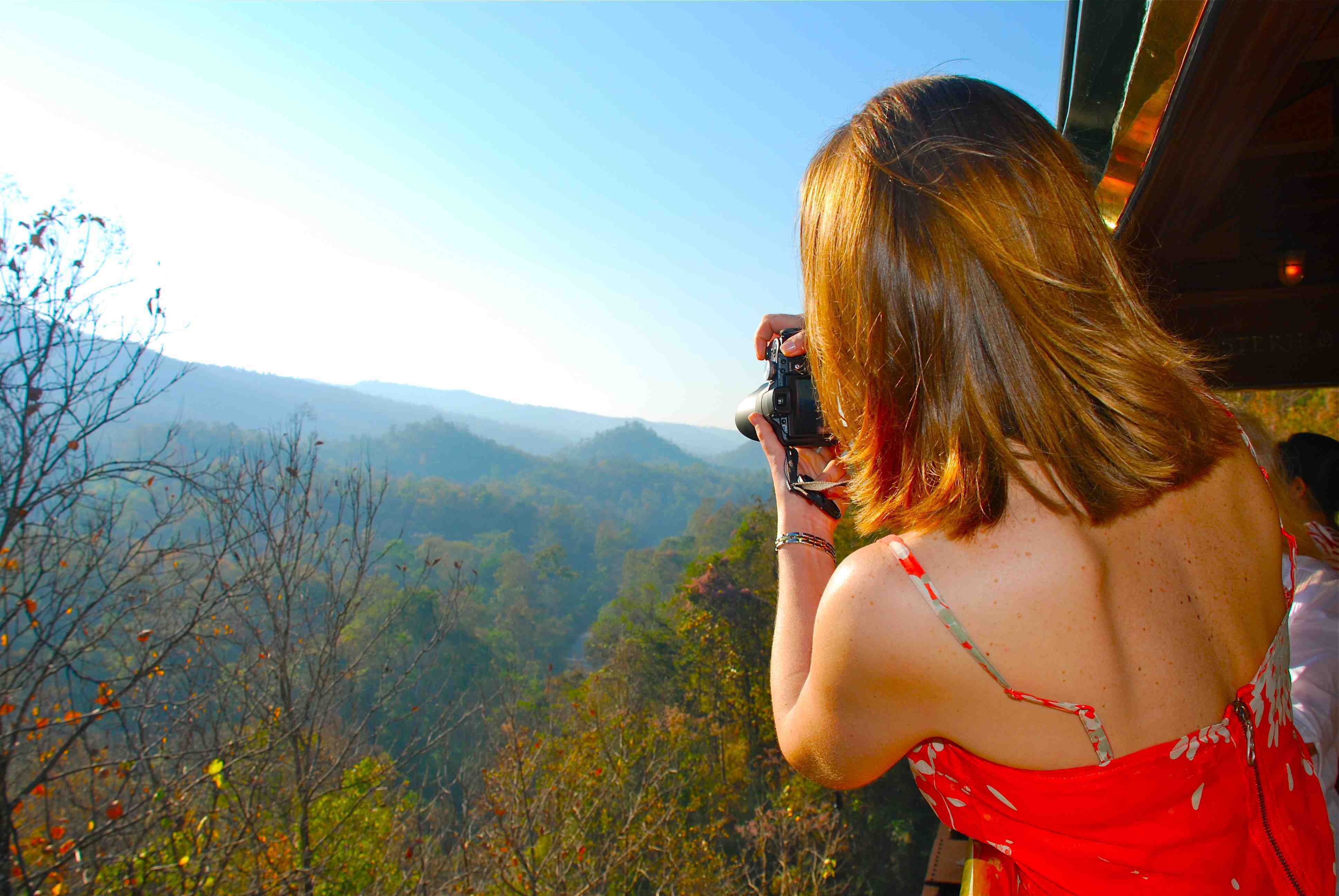
    The Eastern & Oriental Express' rear open-air lounge car is a favorite photo spot for passengers. IRT photo by Eleanor Hardy

  • the Eastern & Oriental Express, normally running between Bangkok and Singapore, but occasionally making week-long trips throughout Thailand and beyond (one of which — “Epic Thailand” — is next year’s Society group tour;
  • the Hiram Bingham, making the three-hour trip in style between Cusco and Machu Picchu in Peru;

N. America has just one appearance on the “World’s Top 25” list, but it’s a stunner: the Royal Canadian Pacific, based in Calgary and operating on a very limited basis—just three trips in 2012.

Bianca Vos on Rovos Rail

Bianca Vos, daughter of Rovos Rail founder Rohan Vos, works full time for her dad. Here she is on the IRT Society's 'Owners' Choice' Cape Town-Dar es Salaam tour last July. IRT photo by Owen Hardy

Last but far from luxurious least is South Africa’s Pride of Africa, run by Rovos Rail, which offers probably the world’s most incredible luxury-rail experiences. Operating all over S. Africa as well as, occasionally, to Namibia, Botswana, Zambia, Zimbabwe and Tanzania, the train overcomes inhospitable climate, lack of infrastructure and a maze of red tape to offer an almost seamless product. Once you’ve ridden with Rovos Rail (which, with 25 IRT Society members, Eleanor and I did last July from Cape Town to Dar es Salaam) you won’t want to see Africa any other way.

The emphasis on luxury in no way denigrates the others on the “Top 25” list. The Budapest-Istanbul Danube Express, Switzerland’s Glacier and Bernina Expresses and Norway’s tiny Flåm Railway all are not-to-miss European railroad experiences.

China’s Shangri-La Express can’t be called a luxury train. But it sure beats riding a regular Chinese train and likely will continue to do so until the much-vaunted Chinese Tangula Express luxury trains begin running (if ever).

Diners on Rocky Mountaineer

IRT Society travelers Gary and Joann Campbell dine aboard the Rocky Mountaineer Goldleaf dome. IRT photo courtesy of Gary Campbell

Over in the Western Hemisphere, Peru’s Andean Explorer offers an unforgettable all-day ride, along the top of the world, from Cusco to Lake Titicaca; farther north, Canada’s Rocky Mountaineer offers a great, all-daylight ride (our advise: splurge for a spot in the GoldLeaf dome).

Half a world away, finally, great railway experiences can be had in Australia, the only continent that can boast two trans-continental trains: the Sydney-Perth Indian Pacific and the Adelaide-Alice Springs-Darwin Ghan. Platinum Service, introduced several years ago, makes the going even better.

So there you have it: the World’s Top 25 Trains for 2012. Again, to download our publication now, click here.

What’s that you say? You have a differing opinion? Please tell us. What are your “Top 25?” Now’s the time to join the conversation!

Gran Lujo: A Grand Upgrade

15 Nov

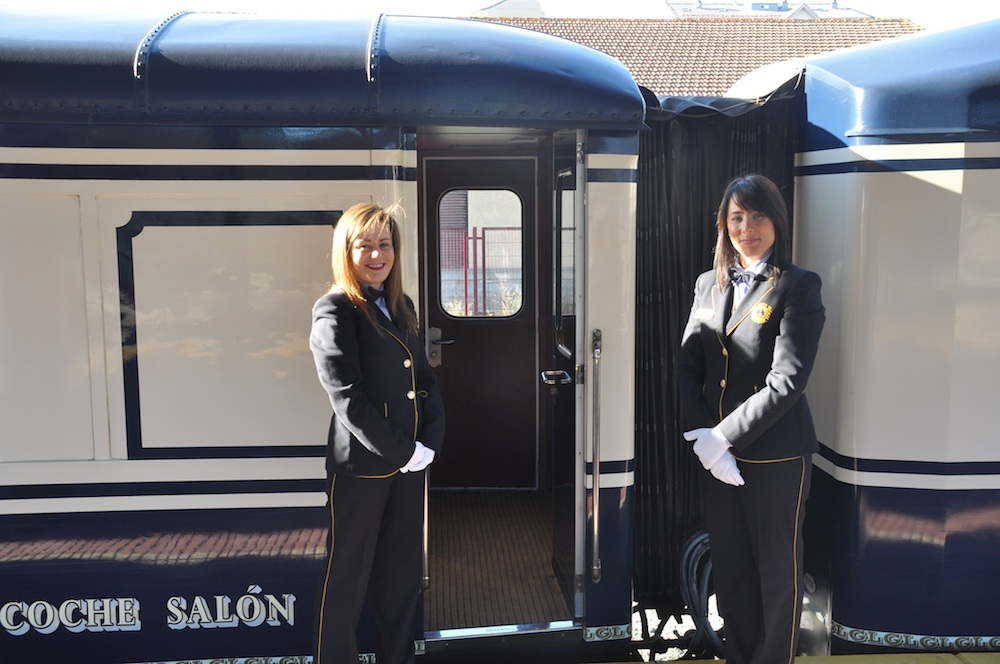
The staff of the El Transcantabrico Gran Lujo welcome passengers aboard in Ferrol, Spain. IRT Photo by Angela Walker.

The neatly uniformed staff snaps to attention as we approach El Transcantábrico Gran Lujo at Ferrol Station. As we settle into the lovely lounge car, the staff serves champagne all around.

Our tour manager, Barbara Callisto, with her charming, infectious smile, introduces the staff, explains the train layout and toasts the trip ahead, first in Spanish, then English. This grand and intimate introduction would set the tone for my trip, which I enjoyed just two weeks ago.

It lived up to some of my expectations and exceeded others. Its operator, FEVE, proved once again that its trains are firmly ensconced in the Society of IRT’s World’s Top 25 Trains list. The Gran Lujo began service in May 2011 as an upgraded version of the El Transcantábrico Clásico, which I already knew was a fabulous train. I had high expectations.

The Gran Lujo comprises refurbished cars from the Clásico train set, with upgrades and improvements throughout. Seven sleeping cars from the Clásico were gutted and redone, doubling the size of the suites and alleviating one of the few complaints of the Clásico experience: cabins that are too small. Each Gran Lujo suite takes up half a train car.
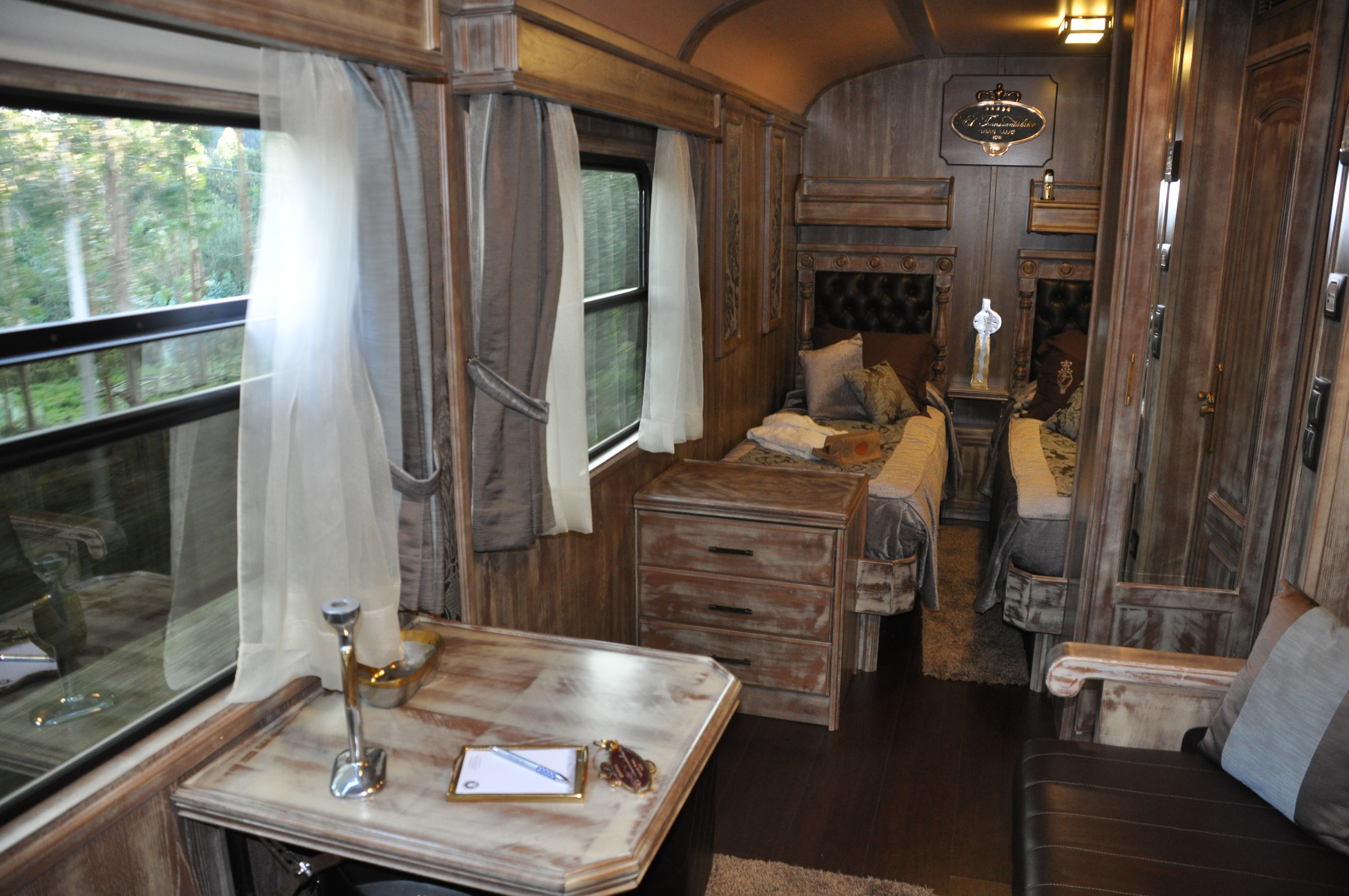
My comfy suite on Gran Lujo. IRT photo by Angela Walker.

My room is Suite Princess 6, one of the four twin-bedded suites on the Gran Lujo. First, I notice the layout—surprisingly spacious for  a narrow-gauge train—twin beds, two windows (which open), couch, table, two stools, wardrobe, chest of drawers, desk with computer and two television screens(!) Not to mention a full en-suite bathroom, complete with the most complicated shower I’ve ever encountered – functions for three shower types, hydro-massage and sauna.

The twin beds are side by side, separated by a narrow aisle. At the end of the one bed is a narrow wardrobe with eight hangers and three shelves; at the end of the other is a chest containing three drawers.

I quickly unpack my things, easily fitting them into the storage space provided. (Note, however, that I am traveling alone. Couples booking a twin-bedded suite may end up fighting over the eight hangers. Double-bedded suites have a wardrobe twice the size of the original, extra hangers to match, but no chest.) Then I tuck my suitcase in a hidden compartment under the couch.
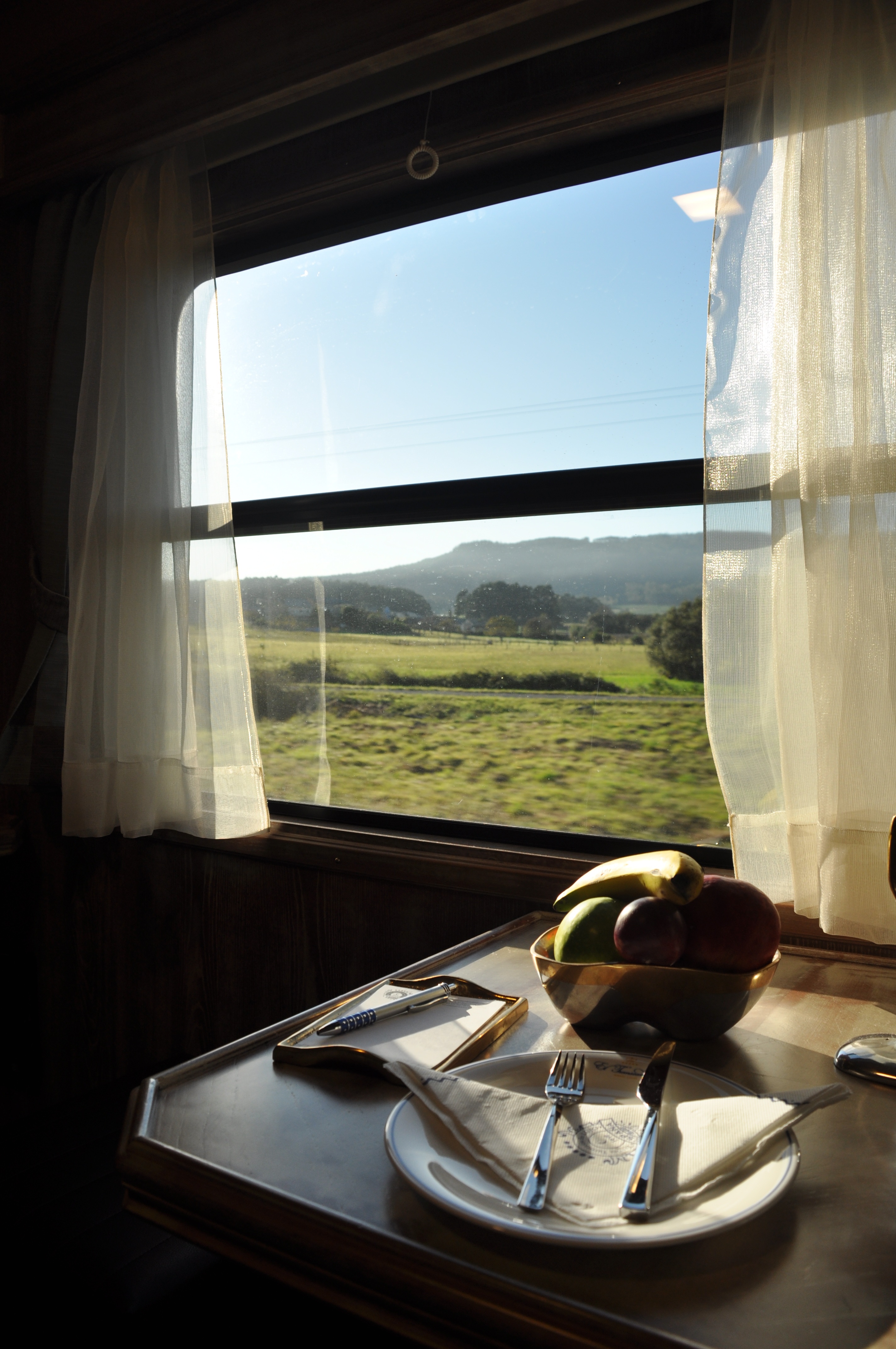
Watching the passing Northern Spain scenery from my suite window. IRT photo by Angela Walker.

I explore every bit of the suite, with distressed wood paneling, decorated in grays and browns. I discover a minibar, safe and several more clever places for storage, including the stools which open for an unexpected storage box.

Technology has been successfully incorporated into the suites – there is digital climate control as well as a panel to operate the cabin “entertainment” — three channels of music and a fourth, which turns on the television screens. If the passing Northern Spain scenery and off-train tours are not enough for you, there are movies, news and weather available, as well as a computer with internet access.

The train has wireless internet, but this does not work while the train is moving, and on my trip is not reliable the first few days, even when the train is stabled .

Each morning breakfast is served on board – a buffet including a variety of breads and sweets, cereal, fruit, yogurt, crackers, meats and cheeses, juices and Spanish tortilla. The biggest draw at breakfast quickly becomes the freshly carved Iberian ham. Delicious!

At breakfast, the efficient staff serves me freshly squeezed orange juice and offers me coffee. They also give me a
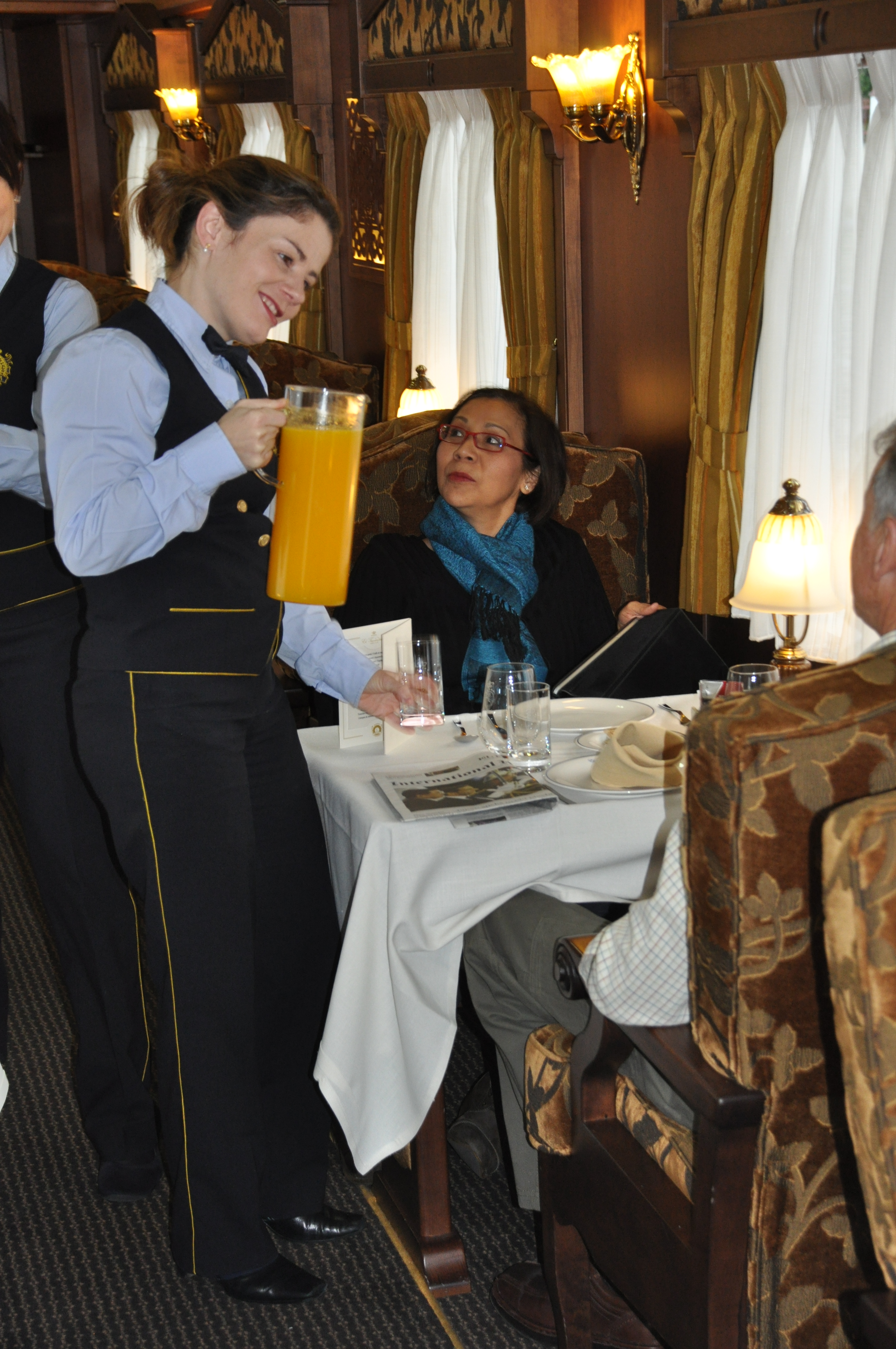
Fresh orange juice is served by the efficient staff of the El Transcantabrico Gran Lujo. IRT photo by Angela Walker.

menu—in addition to the buffet, there is a full breakfast menu, with offerings such as crepes (with chocolate, strawberry, caramel or a variety of jams), caviar canapé, and made-to-order eggs, including omelets with your choice of ham, mushrooms, sausage, bacon and cheese.

After a few days, the staff has memorized the coffee orders and delivers it without asking – in my case, café con leche.

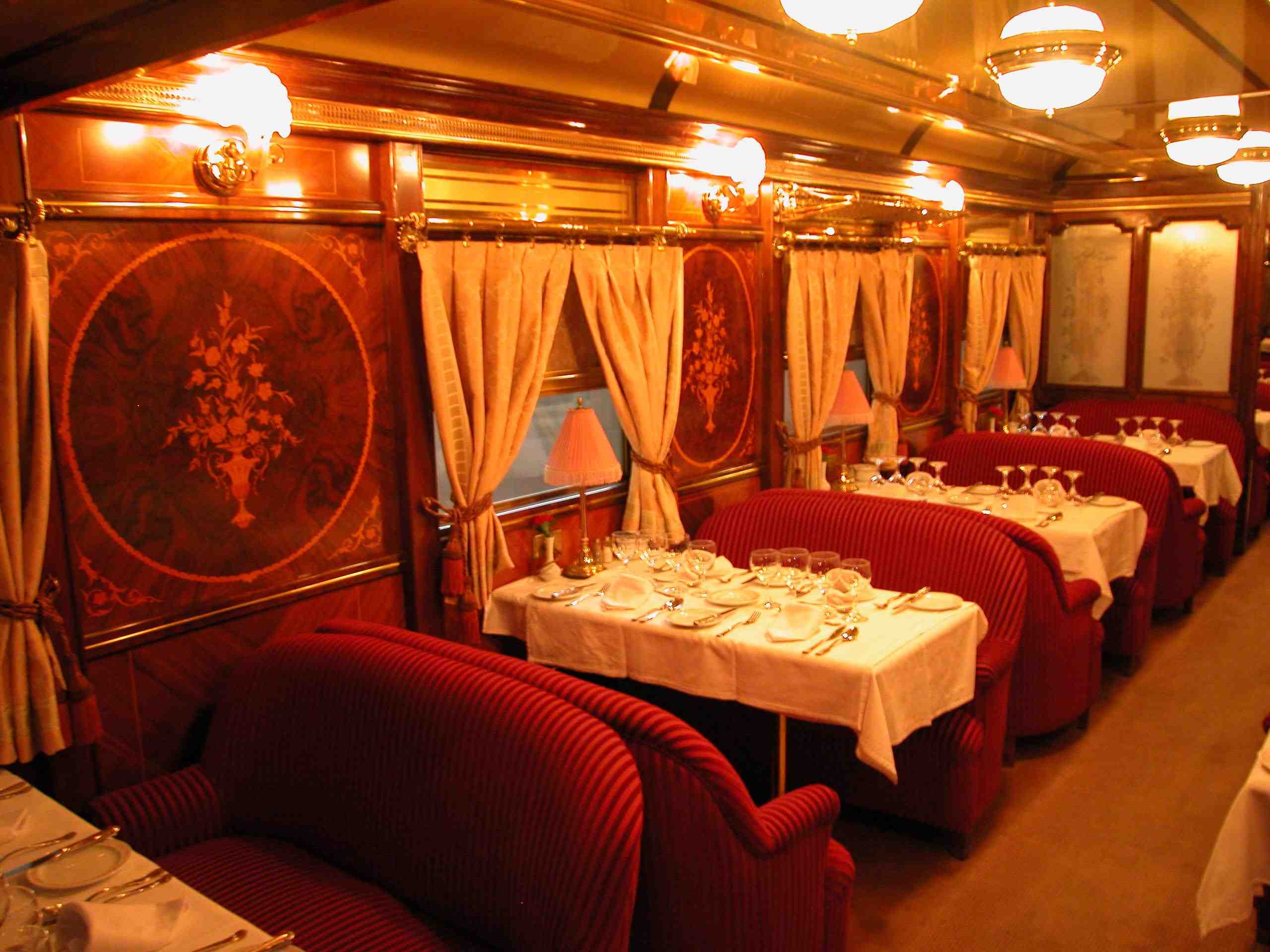
One dining car seats 16 and is decorated in gold and brown, with comfy plush chairs at tables for two. Beautifully latticed panels cover the lights. At each table is a lamp by the window. The other dining car seats 10 at tables for two and is decorated in red and light brown.

There’s a bar at the end of this car, where the morning coffee is brewed and drinks are served throughout the day.

Walking through this dining car offers a glimpse of your week ahead: the walls are decorated with paintings of sightseeing along the route, such as Playa de Catedral (Cathedral Beach), which we will walk along in a few days. Likewise, the beautifully painted panels above the windows colorfully depict stops along the way, as well as the train itself.
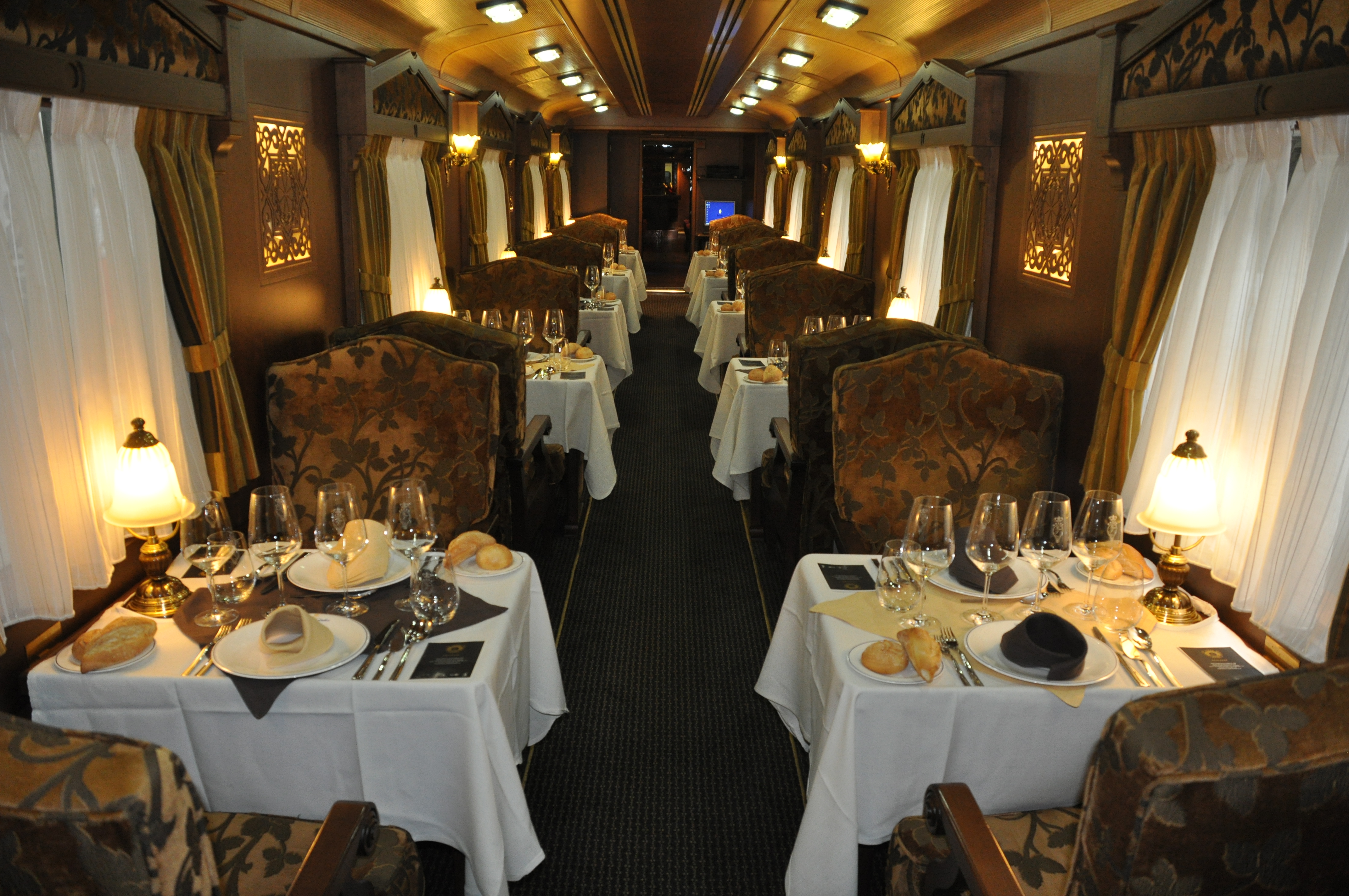
Tables for two in one of the Gran Lujo dining cars set for a four-course lunch on board. IRT photo by Angela Walker.

Table settings are complete with El Transcantábrico plates, cups and glasses. Other than breakfast, we take our meals off the train in restaurants to sample the local cuisine. However, lunch is served on board the last day, giving us a chance to enjoy the service and watch the passing scenery.

It is also the perfect time to enjoy the lounge car, with a panel of panoramic windows, two cream couches, two armchairs and three tables, each with three chairs, seating 17 in all. Many of my fellow passengers linger here after breakfast, reading the numerous newspapers provided daily.

There is also a “disco car” in the consist, where live music is performed several nights during the journey. This has two big couches, two smaller couches and a dance floor, as well as a bar – and stays open and lively until the last person retires. The last night there’s a farewell party in the disco car, where the staff cheers everyone and crowns a “Mr. & Ms. Transcantabrico,” all in good fun.
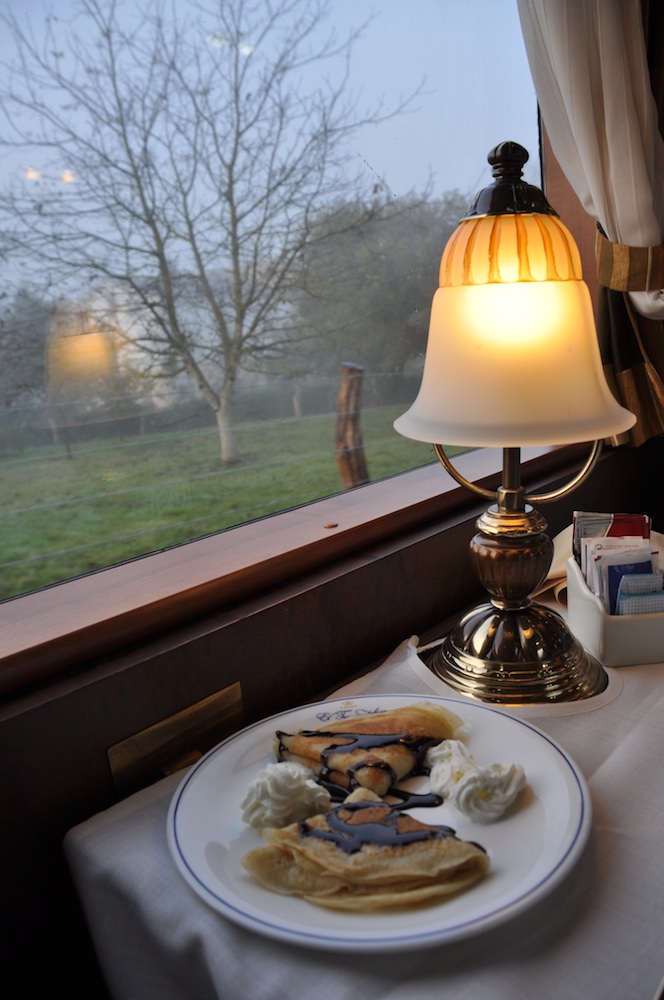
Breakfast crepes were just one of many offerings on Gran Lujo. IRT photo by Angela Walker

The staff are not many, but they’re efficient. There are five serving and two engineers, and the driver, as well as the train manager, Paula. And of course, there is our ever-upbeat, energetic and helpful Barbara, who speaks five languages and happily explains everything in Spanish and English.

Our diverse group includes 18 Spanish-speakers from Spain and Mexico and five English-speakers, hailing from Australia, the U.S., England and Switzerland. Our train, running in late October, is the last of the season. Carrying just 23 passengers, it’s not full, making for an even more intimate experience.
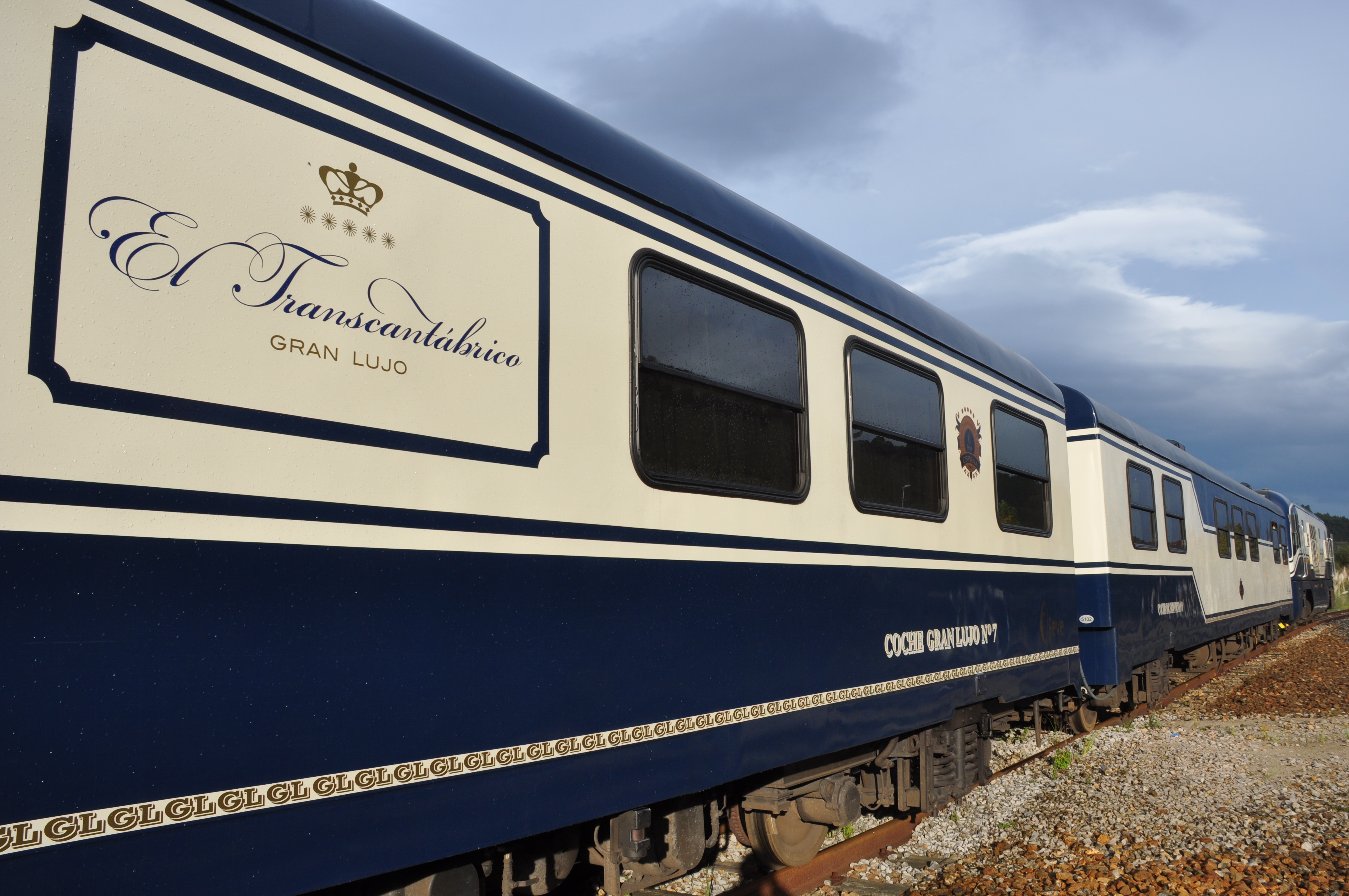
El Transcantabrico Gran Lujo, one of the World’s Top 25 Trains. Photo by Angela Walker.

The Gran Lujo is, without a doubt, an upgrade from the Clásico El Transcantábrico, and well deserves a place among the world’s great luxury trains. The design is well thought-out, making the most of the narrow-gauge space.

The staff is efficient and experienced, and the cabins are attractive, large and comfortable.

Besides the train, the touring and food (so much food!) were highlights, which require separate blog posts of their own.

Have you been on board the new train? Please let us know your impressions! (IRT’s Angela Walker, who has reviewed many of the World’s Top 25 Trains for IRT,  just returned from her eight-day journey across Northern Spain on Gran Lujo, traveling from Santiago to San Sebastian. This is the first of several posts. To see more of her photos, please click here.)
Society Wins 4 Top Awards

21 Oct
Society of IRT 2011 Tour Book

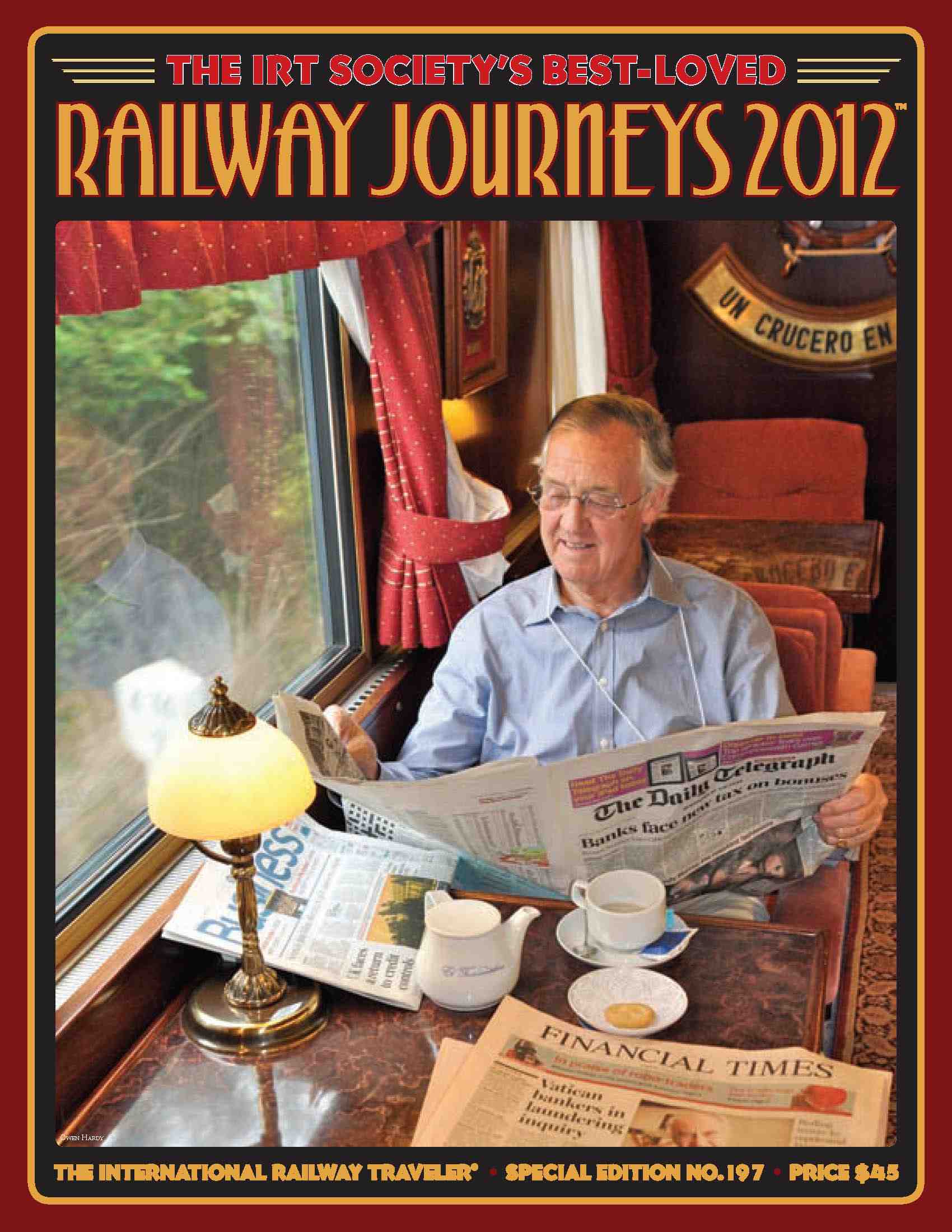
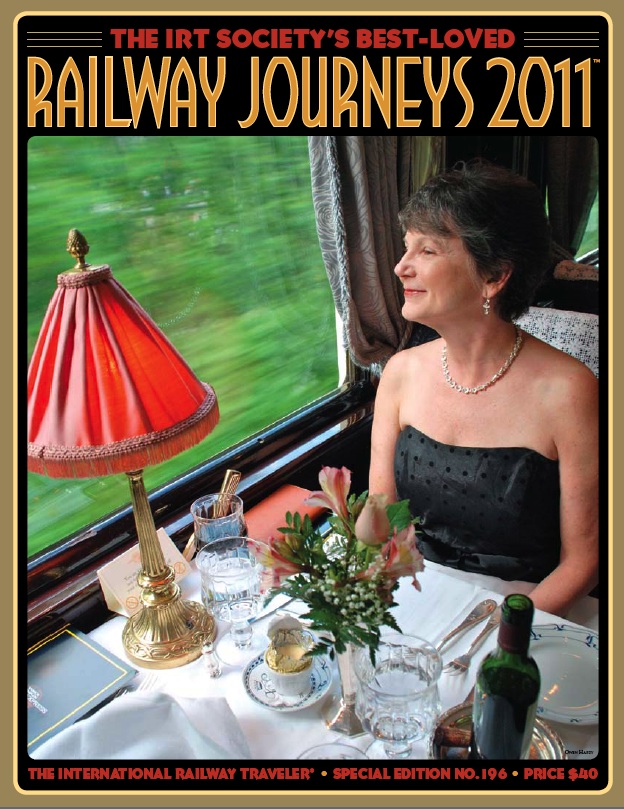
Gold Award winner. Society President Eleanor Hardy appears on cover of the IRT Society's Best-Loved Railway Journeys 2011. Mrs. Hardy is dining aboard the Venice Simplon-Orient-Express. IRT photo by Owen Hardy

The Society of International Railway Travelers®, in business for 28 years selling deluxe and luxury rail travel world-wide, has garnered four top national marketing awards for 2011.

The Society won three Gold Magellan Awards and one Silver Magellan Award, a prestigious travel industry honor sponsored by Travel Weekly, a trade publication and travel media company. The Society of IRT is the only rail specialist to win a Magellan award.

“It’s great news, especially considering the travel industry giants we were up against,” including American Express Travel, Vacations.com and Expedia, said Eleanor Hardy, President. “I am proud that we have produced inspiring publications that encourage people to travel on beautiful trains.”

Gold Awards were announced for the Society’s website (www.irtsociety.com); Track 25, the Society’s blog (www.blog.irtsociety.com), and The IRT Society’s Best-Loved Railway Journeys 2011, a full-color, 60-page annual publication featuring luxury and deluxe rail tours world-wide. It features the World’s Top 25 Trains and the best journeys to take on them, and is full of first-hand reviews and reporting and photography from Society of IRT staff and members.
A full-page magazine ad promoting the Society’s World’s Top 25 Trains™ won a Silver award.

IRT Society web site

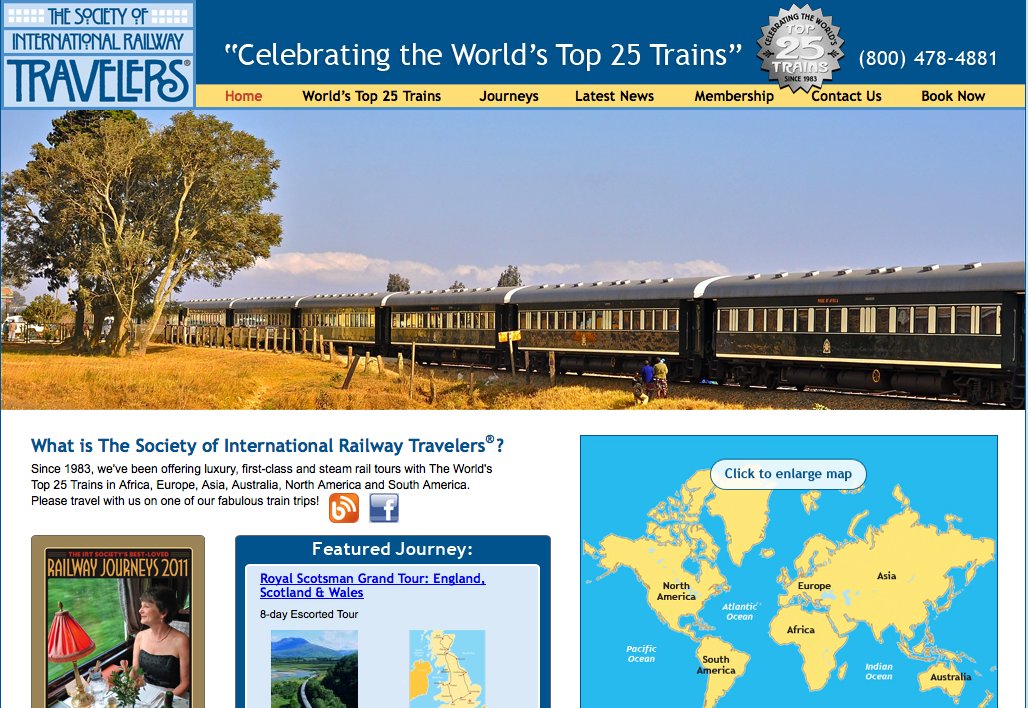
Gold Award Winner: Society of IRT website

Owen Hardy is the publisher of all IRT publications in print and on the web. Angela Walker, Vice President of Operations, is Associate Editor. Stephen Sebree, owner of Moonlight Graphic Works, is the graphic artist and designer for all print publications, ads and IRT logos. All live in Louisville, Kentucky in the United States. The rest of the Society of IRT team includes Mrs. Hardy, managing tour operations, and Margaret Langner, assisting in all areas of IRT operations, including setting up our blog.

Started in 1983 by Owen Hardy, a former Courier-Journal arts critic, the Society was one of the world’s first agencies specializing in international, high-end rail travel. The Society’s World’s Top 25 Trains™ list, begun in 2006, sets an international standard for luxury rail.

The Society’s list includes iconic names, such as the Venice Simplon-Orient-Express and the Golden Eagle Trans-Siberian Express, as well as newcomers, such as India’s Maharajas’ Express.

Owen and Eleanor Hardy on the Blue Train

Owen and Eleanor Hardy on the Blue Train. IRT Photo

“We pride ourselves in having direct experience with the rail journeys we sell,” said Mrs. Hardy, who has personally ridden 20 of the Society’s World’s Top 25 Trains.

In recent years, the Society’s marketing truly has gone global, with new customers from as far away as Australia, New Zealand, China, the Philippines, Brazil and the United Arab Emirates.

We thank you so much for your support — and your news and feedback about your train trips.  That’s what really makes this happen.

For more information on the Society, please call toll-free (800) 478-4881 in the U.S. and Canada; (502) 454-0277 elsewhere, or email tourdesk@irtsociety.com. To see the complete list of 2011 Magellan Award winners, go to www.travelweeklyawards.com

Spain’s Luxury Al-Andalus Resumes Operation in 2012

17 Oct
Al-AndalusSouthern Spain’s opulent, broad-gauge Al-Andalus is scheduled to return to the rails May, 2012, with its 1920s-era cars newly renovated. The train cancelled departures in May, 2005, following problems with its operator, Iberrail. It has been inactive since that time.

“We’re thrilled Al-Andalus is back on the rails,” said Eleanor Hardy, president of The Society of International Railway Travelers®. The Society is a world-wide booking agent for Al-Andalus, whose amenities include a bar, tea room and two dining cars, as well as all-en suite cabins.

The six-day, five-night tour will begin/end in Seville, with stops in Córdoba, Granada, Cádiz and Jerez. The train’s itinerary combines fine dining and wine with visits to iconic Spanish tourist sites, many of whom have won UNESCO World Heritage status.

Tour highlights include visits to the famed Alhambra, the Royal Andalusian School of Equestrian Art, and Doñana Natural Park, largest of its kind in Europe. Owned by RENFE, operator of Spain’s broad-gauge and high-speed services, Al-Andalus will be run by FEVE, the public authority responsible for narrow-
gauge services in N. Spain.
“Al Andalus couldn’t be in better hands,” said Hardy. “Since 1983, FEVE has run the popular luxury train El Transbantábrico with great success. This year it introduced the new luxury service El Transbantábrico Gran Lujo. They’re very experienced in the business of running high-end rail tours.”
Al-Andalus
Al-Andalus prices start at €2,500 (about $3,500 U.S.) per person, double, standard class; €2,950 (about $4,100 U.S.) per person, double, superior class. IRT will review the train soon after its seasons begins next spring.  We’re confident it will be a huge success because IRT guests who took this train before it ceased operation are still talking about it; others have asked about it for years. To book, please call (800) 478-4881 in the U.S. and Canada; elsewhere, please call (502) 454-0277. To see a detailed itinerary, please click here.
Will it be a World’s Top 25 Train? What do you think?

VIA’s Luxury Canadian: Booking to start soon

28 Sep

Editor’s Note (April 2012): The new Deluxe Class on VIA Rail’s Canadian has been delayed, and is now expected to come on board in 2013.  Stay tuned to this blog for updates.

Sunrise on the Canadian

Sunrise on the Canadian. IRT Photo by Bruce Anderson

VIA Rail Canada’s “New Canadian” makes its debut next summer on its tri- weekly Toronto-Vancouver run. VIA has invested $22 million for a total renovation of sleeping cars into what VIA describes as a luxury boutique hotel-on-wheels branded as “Deluxe Sleeper Class.”

These all-bedroom cars will have only six rooms per car, each with en-suite bathroom including private shower, larger windows, and a flat-screen TV. Improvements also include a double bed, leather sofa, and refrigerator along with upgraded linens and amenities.

Deluxe Sleeper Class

VIA's new Deluxe Sleeper Class. Photo/VIA Rail Canada

Passengers also will enjoy priority boarding from dedicated lounges in Toronto and Vancouver, priority luggage handling, a specially assigned attendant and turn-down service, and priority dining car reservations along with all-day room service. Breakfast and afternoon are served in your compartment. Another unique perk: a personal introduction to the train engineer.

In addition to adding the Deluxe Sleeper Class cars,  VIA has upgraded the décor of its traditional Pullman-style sleeping accommodations. And all Deluxe and Touring Class passengers will continue to have access to the renovated diners, Skyline Dome and Park Observation cars. (Renovated Park Cars also will be offering a handicapped accessible bedroom for the first time.)

Gourmet meals aboard Via's Canadian

Gourmet meals aboard VIA Canadian. Photo/VIA Rail Canada

Tickets for Deluxe Sleeper Class can be booked very soon –– VIA agents said the booking starts tomorrow for journeys in this new class starting June, 2012 and going through mid-September. Fares have yet to be published but are said to cost several thousand more per person than the current Sleeper  Touring Class.  Pricing has not been publicly released. For budget-minded travelers, “Comfort Class” — basically coach — is still available, although utilized mostly by local passengers going to or from intermediate stops in route.

With domes no longer in regular Amtrak service, it’s good to know that these unique creations can still be enjoyed three days a week just north of the border in a 1950’s classic American streamliner — but now updated to 21st-Century standards.

The Canadian has been plying the rails between Toronto and Vancouver since it was first introduced by the Canadian Pacific Railway in 1955.

Consistently named one of the “World’s Top 25 Trains” by the Society of International Railway Travelers, this classic Budd-built streamliner remains a throwback to what North American passenger trains were all about, including its art deco lounges and diner, traditional Pullman-style roomettes, bedrooms, and drawing room. It even retains some traditional sections, with privacy provided by a flimsy curtain (think Marilyn Monroe in “Some Like it Hot.”)
Editors note: Car descriptions are based on VIA publicity and have not been personally reviewed, as they are not yet in service. IRT plans to see the new equipment as soon as possible and to sample the new service as soon as it begins next summer. Let us know: is the new deluxe sleeper class something you’ll want to book?
Last Frontier: The Silk Road

22 Sep

(Editor’s note: Author Chris Card Fuller’s story about her 2007 Silk Road trip originally appeared in The International Railway Traveler® magazine, republished here with permission. Please note that although the itinerary is essentially unchanged, the tour operator no longer offers Heritage Class accommodations on the Golden Eagle Trans-Siberian Express.)
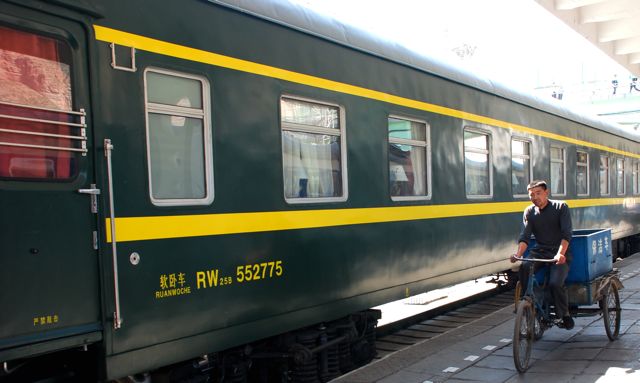
The Shangri-La Express travels in late afternoon sunlight. GW Travel Photo

A gust of wind chases autumn leaves around the pavement. The flash of yellow and gold leaves and purple heather in the intense sunlight comes as a surprise, considering that we’re wedged in between three deserts. I’m just about to catch the perfect video clip of the Golden Eagle Trans-Siberian Express gliding into Dostyk, Kazakhstan.

We’re standing on the platform of Kazakhstan’s border town with China’s Xinjiang province. In 21 days, we will have covered almost 7,000 miles, from Beijing to Moscow, traversing some of the most inhospitable, lowest, hottest terrain on the planet. Until we actually catch some of the sand between our toes and view a dune from our perch on a camel’s back, the magnitude of our journey doesn’t begin to sink in.

Chinese waitress on the Shangri-La Express

Expert tea service - a warm welcome is part of this centuries-old art form. Photo © Chris Card Fuller

This is the famed Silk Route. We’re separated from the world by unforgiving deserts and mountain ranges–the Tian Shan, the Pamirs Karakorum and the Kopa Degh. And to get to places like Mary, Turkmenistan, by way of Samarkand and Bukara in Uzbekistan and Almaty in Kazakhstan, you must have the proper visas. Camels can walk across these borders easier than tourists. Traveling by private train is one of the few ways you can get there.

We greet 90 west-to-east passengers emerging from their shiny blue compartments of the Golden Eagle Trans-Siberian Express, assisted by smartly uniformed Russian railway car attendants. They’ve just finished the first half of their trek which began in Moscow with stops in Volgograd, Khiva, Samarkand, Bukara, Almaty and Tashkent, before switching trains with us to finish the second half of their voyage on ‘our’ train the Shangri-la Express. Ahead of them lies the Tarim Basin, the Gobi Desert, and the Mogao’s Buddhist caves, carved between 1,500 and 1,600 years ago. In Xian, 6,000 terracotta warriors await their arrival. They’ll finish up where we began – at the Peninsula Hotel in Beijing, China’s 21st century capital and home to the 2008 Summer Olympics.

Chris Fuller aboard the Trans-Siberian Express

The author's husband, Chris Fuller, relaxes in the dining car after a meal aboard the Trans-Siberian Express, one of two trains used on the Silk Road tour. Photo © Chris Card Fuller

East-bound passengers will be learning to use chopsticks just about the time that we’re getting comfy in a Kazakh yurt. In the flurry of video and picture-taking with Kazakstan’s neatly turned-out border guards, we gather up our plunder – silks from Xian and pashminas from Turpan – before boarding the Golden Eagle Express. The blue and gold compartments are a welcome sight: all three categories are comfortable: Heritage class with twin beds, Silver Class with a double bed, and additional overhead bunk, a private shower and toilet facilities, closet, and TV/Video/CD player. Gold Class offers a little more closet space and shower space than Silver Class plus easy access to the bar car and the Gold Dining Car. Generous serving of vodka, unlimited wine with meals served in crystal stemware, caviar and sturgeon for our welcome and farewell dinners, 24 hour coffee and tea service in our compartments – such luxurious details – can be distracting. We’re traversing the harshest of deserts and mountain passes in the protective cocoon of our air-conditioned private train.

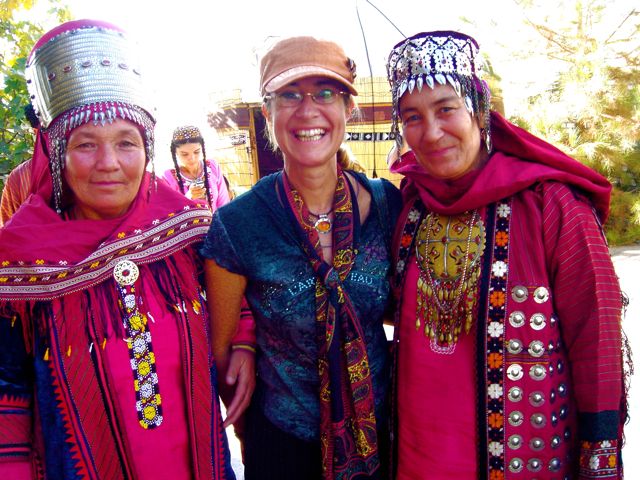
Village luncheon hosts near Mary, Turkmenistan flank the author. Photo © Chris Card Fuller

Village luncheon hosts near Mary, Turkmenistan flank the author. Photo © Chris Card Fuller

If you think train travel over several thousand miles of desert might be boring, it isn’t…

Oasis towns like Turpan in Xinjiang, China are lush and brimming with vineyards. Poplar trees line the newly constructed asphalt Silk Road highway. In Samarkand, nothing is quite as exotic as the haute-couture-clad Uzbeki models tearing up the catwalk during our private fashion show in a merchant’s former private palace.

Almaty, Kazakhstan’s modern capital city, is the antithesis of rustic. It may be where the apple originated, but you’ll find more stretch limos here than apple orchards. We’re entertained in a carpeted yurt restaurant, but the performers sing arias just as proficiently as traditional folksongs.

A worker delivers a load of supplies for the train during one of the many stops between Lanzhou and Golmud. Photo by Angela Walker, IRT

A worker delivers a load of supplies for the Shangri-La Express during one of the many stops between Lanzhou and Golmud. Photo by Angela Walker, © IRT

Food in Central Asia is also a pleasant surprise. For local lunches and dinners, we’re served hearty soups, spiced meats and plentiful vegetables with rice pilaf and fresh pita bread. Most meals begin with a plate of pickled raw vegetables such as cucumbers and beets, local cheeses and olives. Sweet melons and dried fruits are specialties of these oases towns.

“We are the lowest, the hottest, and the sweetest place on earth,” is how Zeba, a Turpan resident guide, describes her oasis home in the Taklimakan desert. The desert offers up a few, but not all, of its secrets.

At the Urumchi Provincial museum in China’s Xinjiang province, we meet the ‘Loulan Beauty’. This blond-haired Indo-European petrified corpse was officially dated at 3,700-years-old, yet some archeologists believe she may be even older.

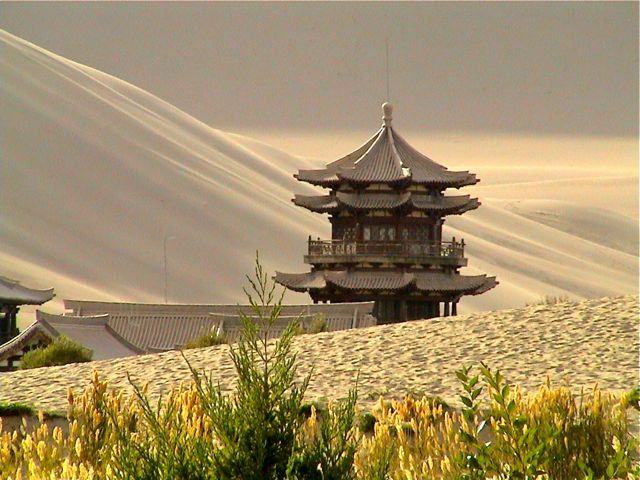
Crescent Spring

Surrounded by sand dunes, Crescent Spring appears like a mirage. Photo © Chris Card Fuller

The 2,300-year-old ruins of Jiaohe city near Turpan used to be a Han-era garrison town built to fend off northern marauders. This complex of carefully laid-out city streets has been described as “the largest, oldest and best-preserved earthen city in the world.”

I’m no history expert. My Tang and Han dynasty dates usually get twisted up in a knot, but of one thing, I’m dead certain: As soon as this trip ends, I’ll want to hop right back on the train and see it all again.

(When not traveling, Chris Card Fuller divides her time between Paris, France and Florida.)

For more information on the Silk Road tour, please click here.

Rovos: Club-Like Comfort from Cape Town to Dar es Salaam

1 Sep

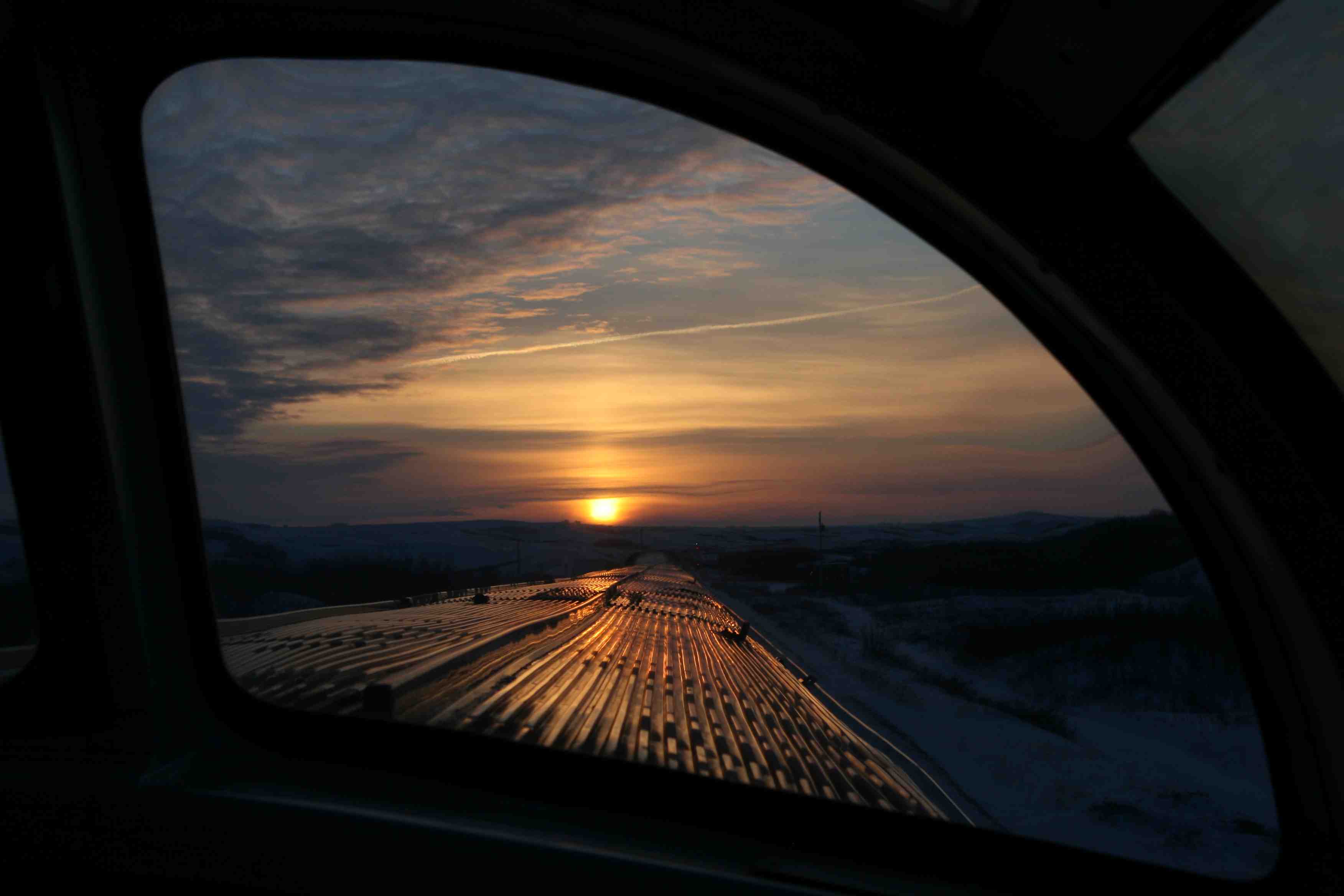
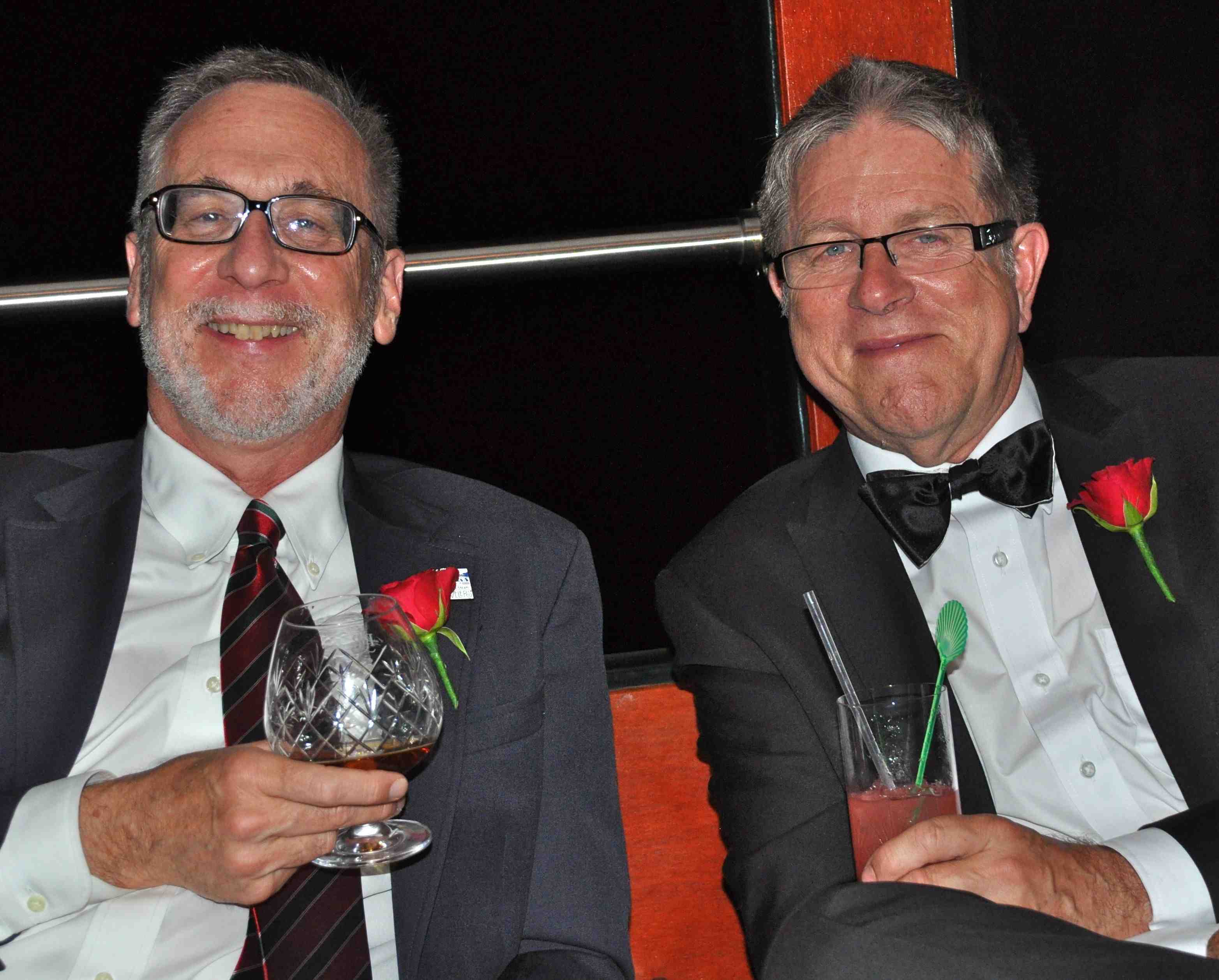
Society CEO Owen Hardy and member David Cowley, spruced up for the final dinner before arrival in Dar es Salaam, share a drink at the outdoor platform in the rear lounge car. IRT Photo by Eleanor Hardy

(Continued from Part 1)

While the Eastern & Oriental Express or the Venice Simplon-Orient-Express probably win the top awards for utter beauty, Rovos Rail’s Pride of Africa is more like a comfortable London club.

That’s where we spent some of the best moments of our recent Cape Town – Dar es Salaam “Owners’ Choice” group tour last month. (To read my first installment, click here.)

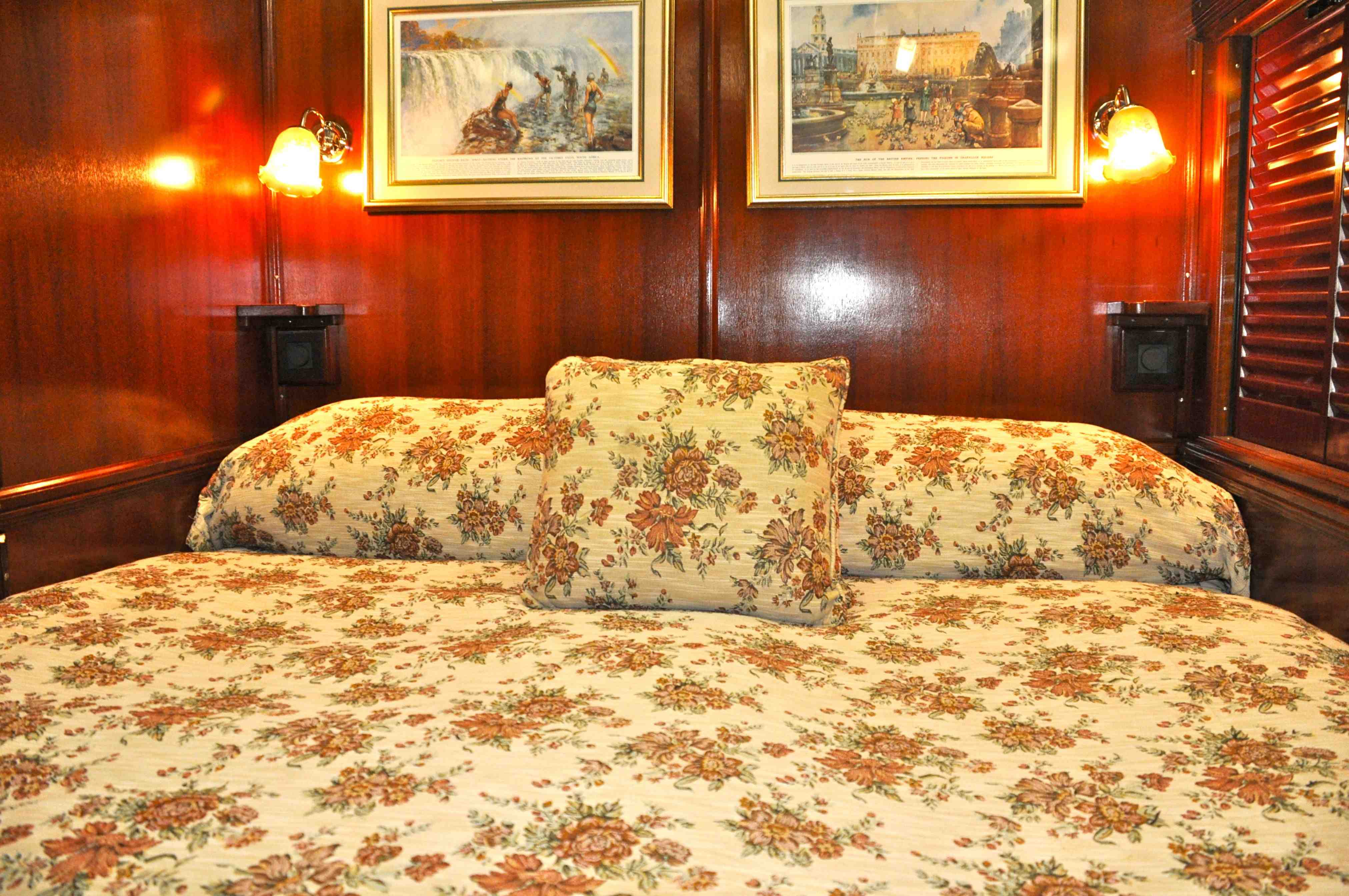
Interiors, constructed in Rovos’ Capital Park headquarters in Pretoria, are outfitted in dark, varnished Rhodesian teak, with polished brass, thick carpeting and, in the diners, gleaming silver, crystal and cutlery.

King size bed in Rovos Rail Deluxe Suite. IRT photo by Eleanor Hardy

Our deluxe suite was spacious and tastefully appointed, with all the standard amenities – shampoo, conditioner, fine soap, shoe mitt, etc. — one would expect of a five-star hotel.  We loved it: it was the biggest compartment we have experienced. And if we were delighted, our IRT guests in the Royal Suite, with its two armchairs and full-sized Victorian porcelain bathtub, were thrilled with their half-a-train-car accommodation.

Our first day on the train commenced as so many would thereafter: with leisure spent in the privacy of our cabin, followed by a visit down to the rear lounge car to enjoy its over-sized outdoor section. Soon afterwards, we heard the mellifluous sound of chimes,  rung by a Rovos Rail staff member walking the length of the train, signaling that lunch was being served.

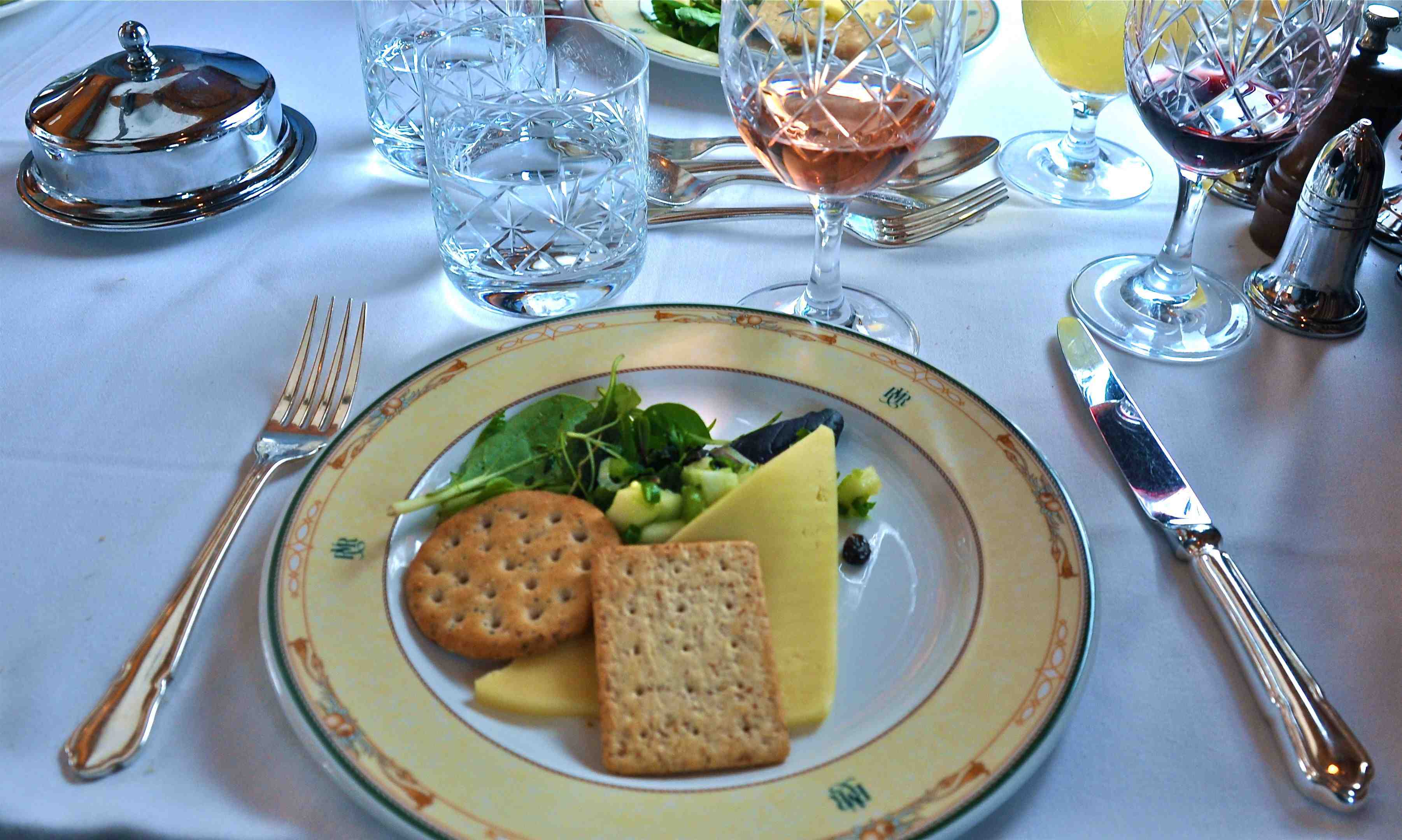
Meals on Rovos Rail are grand affairs. Lunch and dinner typically include four courses.

Cheese course is served at lunch and dinner. IRT photo by Eleanor Hardy

Following a starter is the main course, which could be fish, lamb, beef or, more exotically: springbok (tastes like steak) or ostrich (also tastes like steak). Imaginative vegetarian options also are available. Next comes a cheese course, followed by dessert and coffee or tea.

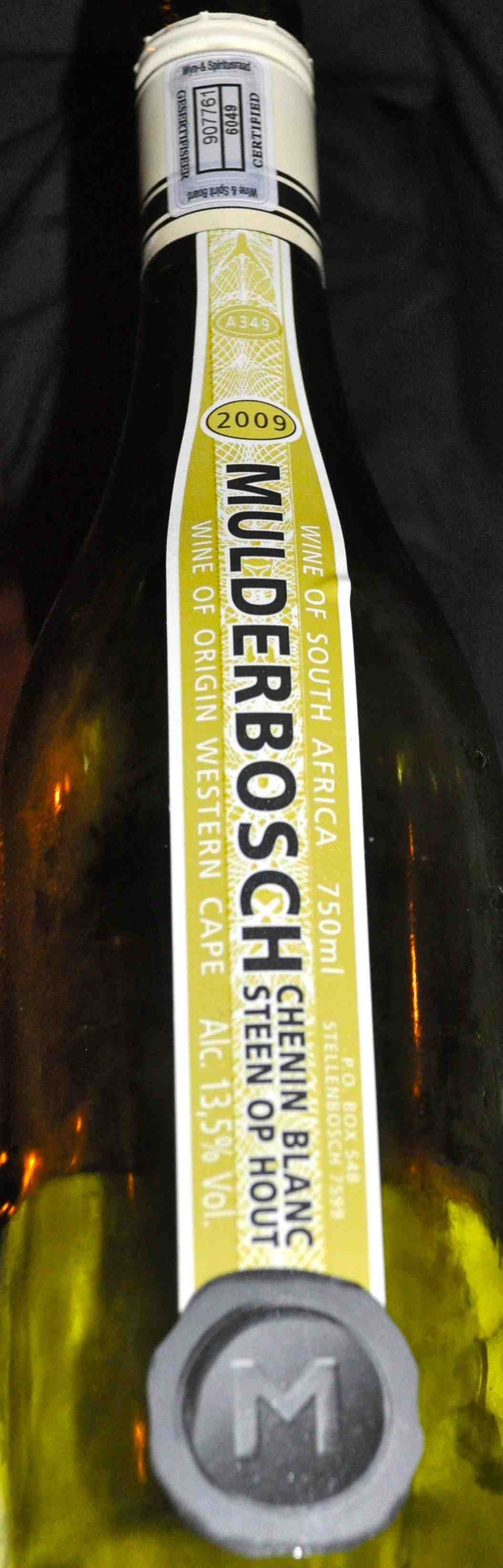
Mulderbosch Chenin Blanc

Mulderbosch Chenin Blanc

A word of warning about meals: each course is paired with an excellent South African wine. On our trip, wine stewards Gareth van Wyk and Michael van Rooyen enthusiastically described their wines’ provenance and taste characteristics.

But while sometimes one wine will work for two courses, many times each course will be paired with a different wine, including, at dessert, a liqueur such as Kahlua or Frangelico, or one of the many fine South African dessert wines.

If you’re like me, you’ll want to try them all, but the cumulative effect can be debilitating. And don’t forget: there are many all-train days, when your natural tendency will be to move following the meal to one of the two lounges, where more (“free”) wine and spirits are flowing. So pace yourself.

Fidgety types might wonder what one does all day on a train. On the Pride of Africa, the list of possibilities is long – and each passenger seems to develop his own routine and favorite perch.

In our case, the most serious photographers hung out at the rear. In fact, they rarely left their privileged positions.

Waving children

Children love trains everywhere – including Africa. IRT photo by Eleanor Hardy

(So don’t be afraid to speak up and request equal time. There’s nothing better than viewing an African sunset from that vantage point. And whole villages seem to empty their children beside the tracks to wave to the train people rattling by. Waving back, one can’t help but feel a bit like visiting royalty.)

Other people liked the indoor section of the lounge, with its sumptuous cakes and finger sandwiches during afternoon tea, or the ready drinks from the bar, available anytime.

Still others liked the front lounge and the services of Nicholas Schofield, the train historian, who delivered five lectures, each about an hour, on African history, politics and culture in his singular, breathless style, which makes him impossible not to enjoy.

Unlike many on-board academics, who seem to hide in their cabins between lectures, the ever-chipper Mr. Schofield makes himself available to all. Arrive early to get the best seats; double-check timings daily because they are subject to change.

Looking out a Rovos Rail window.

IRT Society President Eleanor Hardy enjoys her favorite pasttime: looking out her compartment window. IRT photo by Owen Hardy

Another option is to visit hairdresser Craig Geater’s salon – included in your fare. After almost 3 weeks in Africa, I definitely was ready for a haircut and beard trim, which Craig expertly provided in his tiny quarters. But be reasonable in your expectations. You’re in a moving, sometimes jolting train, after all, so don’t ask for a shave with a straight-edge razor. No one wants an impromptu performance of Sweeney Todd. But it was a blast to be rolling along, Tanzania’s gorges and mountains rolling by, while Craig trimmed our hair.

Finally, if you’re the quieter type, you might prefer simply sitting in your private room, looking out of one of the multiple windows, as did IRT travelers Sam and Betty Nuckolls. Sipping their Jack Daniels, they happily watched Africa unfurl as if they had a front-row seat at an old-fashioned Cinerama movie theatre.

All in all, it’s a great way to travel.

(For up-to-date price and date info, click here: Rovos Rail Cape Town – Dar es Salaam)